News · Japan regulation
PMDA ORANGE Letter No.30: filter mix-up corrected, qualification vague
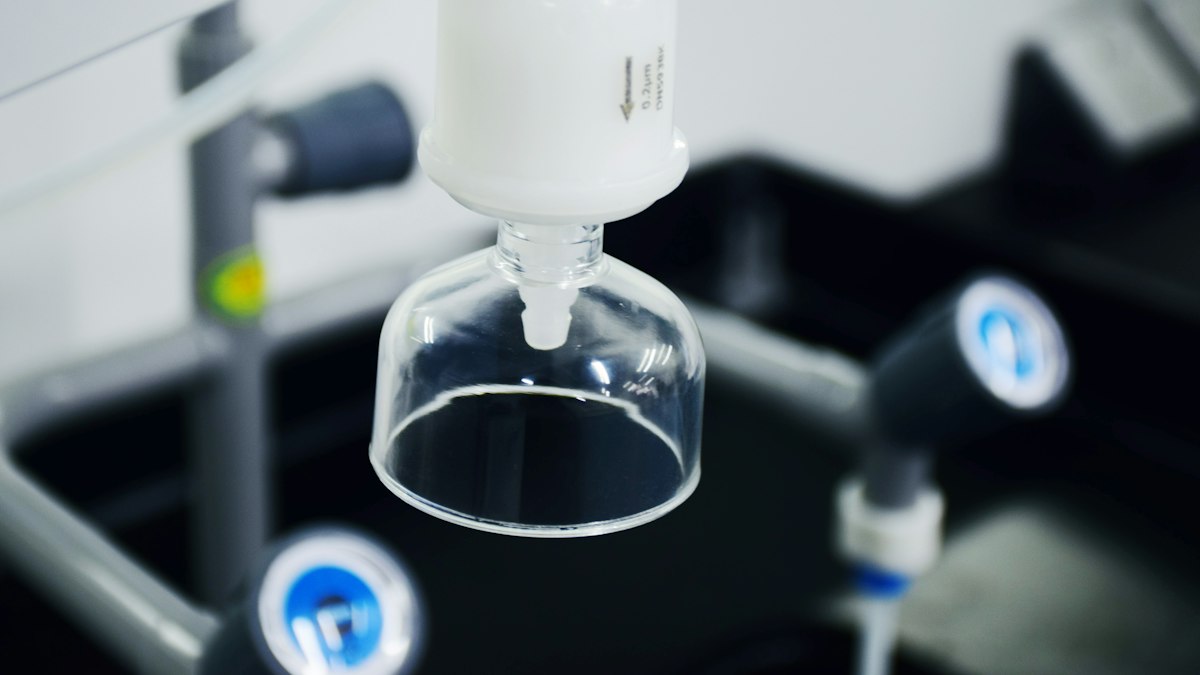
Photo: RephiLe water / Unsplash
Japan's Pharmaceuticals and Medical Devices Agency (PMDA) published ORANGE Letter No.30, "Serious defects revealed by a sterility test failure (Part 2)", on November 24, 2026. ORANGE Letters are PMDA's rapid alerts on findings from its GMP and GCTP inspections. This one describes, without identifying it, a sterile drug product site in Japan where corrective action had been taken over the misinstallation of filters of near-identical appearance, and a fundamental problem still remained in how the manufacturing department managed operator qualification.
Corrective action on every cause, with the qualification criteria left vague
What PMDA points to is not a missing corrective action but the evaluation system left behind. Each of the causes that led to the mix-up, and the root cause, had been given its own corrective action: revision of the relevant procedures and training, together with measures on staff assignment. Vague evaluation criteria and evaluation methods for operator qualification nonetheless remained as an unaddressed, hidden problem, and because operators without sufficient skill could be assigned as qualified, PMDA states that preventive action was inadequate.
The letter cites Articles 6, 15 and 19 of the GMP Ministerial Ordinance (MHLW Ordinance No. 179 of 2004), among others. Part 1 (No.29) reported that the misinstallation came to light while the site investigated a sterility test failure, and that the deviation happened on a trial run lot immediately before process validation (PV), in the compressed air filter used to pressure-transfer the drug solution.
The same pair of filters mixed up twice: 0.2 µm hydrophobic and 5 µm hydrophilic
The mix-up came in two stages. The operator meant to bring in a 0.2 µm hydrophobic filter and took a 5 µm hydrophilic filter of near-identical appearance instead. A part number check after the transfer caught it, and the operator decided to return it to the storeroom. The shelf in the pass room (material airlock) for taking items out of the clean room was full, so the inbound pass room was used to remove the wrong filter instead, and the correct filter came in through that same pass room. Both filters ended up mixed on one shelf, and the operator picked the wrong one again.
The chance to detect the error was lost at the filter integrity test. Believing the correct filter had been prepared, the operator started the test with the procedure that applies to a hydrophobic filter, and water leaked from the downstream side. The operator did not recognize that as abnormal, hurriedly closed off the downstream side and continued the test. It passed by chance, and the wrong filter went into use.
Root cause: an operator not qualified to work alone, working alone
The filter was prepared by an inexperienced operator who held no qualification for unsupervised work. The experienced operator was absent that day and no replacement was brought in, and PMDA states that management of staff assignment had become a formality. The headcount on the floor was in place.
Human error is a problem of the system and, beyond that, of the organization, PMDA writes, asking sites to find the time that developing people and improving work need.
What to check in operator qualification and filter control
Start with the evaluation criteria and evaluation methods for operator qualification. PMDA lists three Check Points. The first is objective evaluation criteria and evaluation methods, both for assessing the effectiveness of training and for qualifying operators. The second is a mechanism that keeps personnel with the needed skills and aptitude in place at all times, not headcount alone. The third is a periodic overview of deviations caused by human error and of laboratory errors, with effective measures against recurrence. Whether a route exists for filling in when the experienced operator is off is for the manufacturer to check.
On materials and equipment, look at the point in the instructions where the part number of a look-alike material is checked, and at whether the separate use of pass rooms holds when a shelf is full. For the integrity test, look for criteria that stop the test and raise a report when something unexpected appears, such as water leaking from the downstream side. Then check that the filter's pore size and membrane material, hydrophobic or hydrophilic, match the integrity test procedure applied. Check all of this together with how deviation management and CAPA are run. An integrity test on a filter for gas and one on a sterilizing-grade filter for liquid do not measure the same thing.
PMDA opened applications on November 2 for its 6th GMP Round Table meeting, on the handling of OOS results, with a November 30 deadline.
Sources
- ORANGE Letter No.30: serious defects revealed by a sterility test failure, Part 2 (Japanese, PDF). Pharmaceuticals and Medical Devices Agency (PMDA), Nov 2026.
- Initiatives for quality assurance: list of ORANGE Letters (Japanese page). Pharmaceuticals and Medical Devices Agency (PMDA), Nov 2026.
- ORANGE Letter No.29: serious defects revealed by a sterility test failure, Part 1 (Japanese, PDF). Pharmaceuticals and Medical Devices Agency (PMDA), Sep 2026.
- 6th GMP Round Table meeting: notice of the meeting (Japanese page). Pharmaceuticals and Medical Devices Agency (PMDA), Nov 2026.