Japan guide · Resin selection
How to choose a chromatography resin for mAb purification
Photo: Spencer Davis / Unsplash
Picking the resin with the biggest binding capacity in the catalog looks like the obvious move. It only works if the numbers were measured under the same conditions, and they rarely are. Cytiva publishes about 80 mg of antibody per mL of MabSelect PrismA at a residence time of 6 minutes (the time the feed takes to pass through the resin bed), about 65 mg/mL at 4 minutes, and about 40 mg/mL at 2 minutes, the last figure from the prepacked-column literature. Same resin, and the number halves.
So what you compare is not the maximum capacity. It is the capacity at your own operating conditions, and how long that capacity survives repeated cleaning. Cytiva's estimate puts the Protein A resin cost at about $67 per gram of antibody if the resin is reused 5 times, and about $3 per gram at 100 reuses. Protein A resin is among the most expensive materials in antibody purification, and its unit cost is set mostly by how many cycles it lasts.
If you buy resin, sell it, or check lot records as QA, this guide shows how to read a capacity claim, how to build a shortlist from the impurities you need to remove, and which questions to put to the supplier.
A resin is judged by its hundredth cycle, not its first
Chromatography resin (also called media or a support) is a porous bead packed into a column. The surface and the inside of the pores carry ligands, the parts that stick to the antibody or to impurities. Differences in how strongly things stick are what separate the antibody from everything else.
In manufacturing, the same column runs dozens or hundreds of times. A clean separation on the first run is therefore not enough. The real test is whether binding capacity and selectivity hold after cleaning.
Cytiva ran the numbers for a single-use process with a 2,000 L culture at 3 g/L antibody. Protein A resin made up 19% of total cost for a clinical campaign of 4 batches, and 3% for a commercial process that reuses the resin 200 times. Early in development the resin weighs heavily on cost, and the share shrinks as the number of reuses grows. How cleaning conditions set resin life is covered in Protein A resin lifetime and CIP (in Japanese) and Protein A resin lifetime and cost (in Japanese).
Treat resin selection as part of designing the operation, including how many times you will cycle the resin, not as a comparison of consumable prices.
Start from the impurity you need to remove
Resins fall into five modes, defined by what they bind. Choose in that order: begin with what you want to remove, and look at resin names last.
Protein A binds the Fc region of the antibody. It captures the antibody from the culture fluid and removes most host cell protein (HCP) and DNA in one step. It runs in bind-elute mode: the antibody sticks to the resin, then is released and collected.
Cation exchange (CEX) binds positively charged molecules. It removes aggregates, charge variants (antibodies that differ in charge), leached Protein A and some HCP. Bind-elute is the standard, though flow-through is also used. In flow-through mode the antibody passes straight through and the impurities stay on the resin.
Anion exchange (AEX) binds negatively charged impurities: DNA, endotoxin, virus and acidic HCP. Flow-through is the standard there.
Hydrophobic interaction chromatography (HIC) binds hydrophobic surfaces, so it targets aggregates and hydrophobic, denatured antibody. It runs in bind-elute mode under high salt.
Mixed-mode resin binds by both charge and hydrophobicity. It removes aggregates and HCP and is less affected by salt concentration. How you run it depends on the case.
Bind-elute or flow-through changes the column size you need and how much feed preparation you do. CEX is covered in more detail in CEX bind-elute versus flow-through (in Japanese).
The standard antibody train has three columns. Protein A captures the antibody, and its acidic eluate is used for low-pH virus inactivation (in Japanese). CEX follows in bind-elute mode, and AEX in flow-through mode. The AEX flow-through step also counts as a virus reduction step.
The sequence is not fixed. An antibody whose aggregates are hard to remove may need HIC or mixed-mode added. A molecule that keeps HCP may get a mixed-mode step at the end to push removal further. What you add depends on which impurity is left, which you read from your aggregate, purity and charge variant assays. Later-stage thinking is in antibody purification polishing (in Japanese), and the ion exchange choices are in ion exchange resin selection.
Narrow your candidates by the list of impurities left in your own antibody, not by resin names.
A catalog capacity is a number with conditions attached
Dynamic binding capacity (DBC) is how many milligrams of antibody load onto 1 mL of resin while the liquid is flowing.
Three conditions travel with that number. The first is residence time: how long the liquid takes to pass through the bed. The shorter it is, the smaller the capacity. The second is the breakthrough percentage, meaning the point where antibody concentration at the outlet reaches a stated percent of the inlet concentration. A value read at 10% breakthrough is larger than one read at 5%. The third is the antibody used in the test, its type and its concentration. If your antibody differs, your number differs.
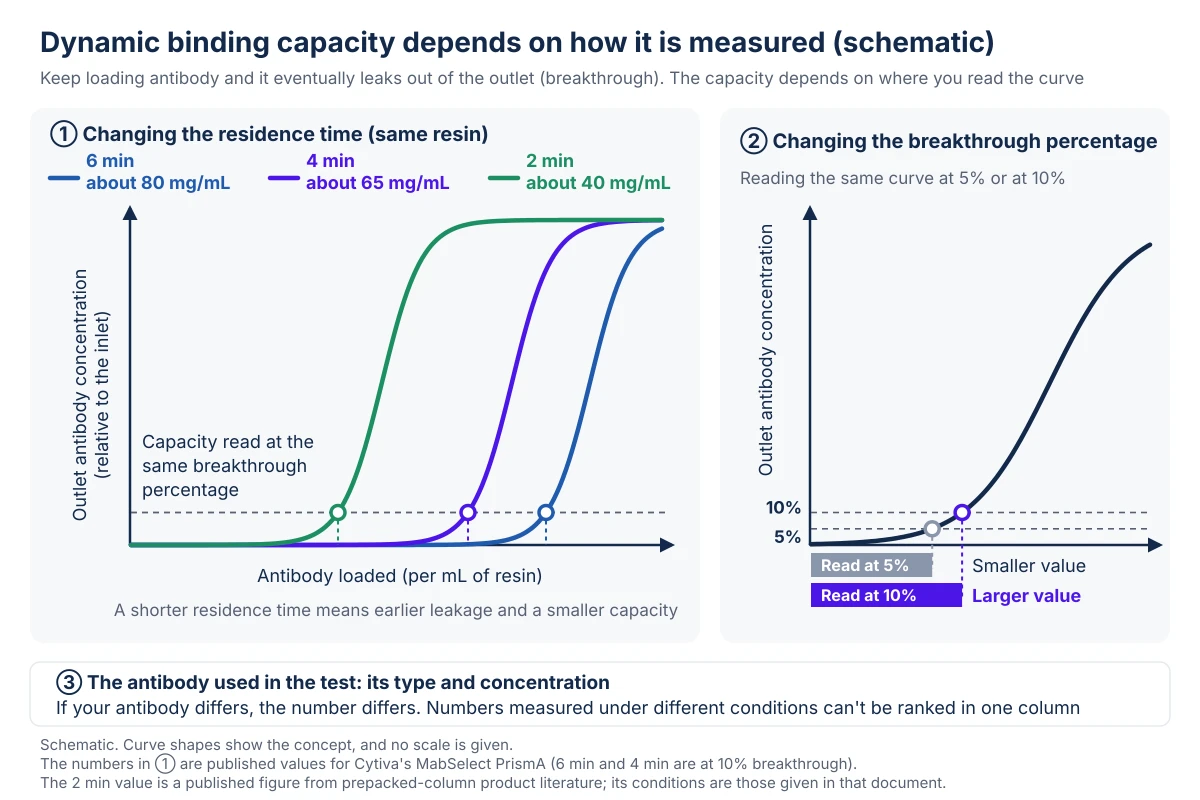
Numbers measured under different conditions can't be put in one column and ranked. A published DBC is not a ranking of products. It tells you which conditions that product handles best.
Protein A resins come from many suppliers: MabSelect from Cytiva, TOYOPEARL from Tosoh, POROS from Thermo Fisher, Praesto from Purolite, Amsphere from JSR, and Eshmuno from Merck. They differentiate on particle size, base matrix and ligand. Cytiva has also announced a new high-capacity resin, MabSelect PrismA X.
Capacity and productivity do not move together. In the opening example, going from 6 minutes to 2 minutes halves the capacity, but the flow rate triples. The resin then takes up about 1.5 times as much antibody per minute. Looking at loading speed alone, a shorter residence time wins. What you need to compare is the whole cycle, including wash and elution time. The residence time, linear velocity and load calculator lets you check how these relate.
When you measure DBC yourself, record the breakthrough percentage, the residence time and the antibody concentration every time. A measurement missing any of the three can't be read again, even by you, six months later. Compare against the supplier's value only after the conditions match.
Ask which residence time, breakthrough percentage and antibody a capacity number was measured with before you let it into a comparison.
Alkaline tolerance sets the cost per gram
The cost of Protein A resin is not the performance of one run. It is the unit price divided by the number of times the resin is reused.
By Cytiva's estimate, the same resin costs about $67 per gram of antibody at 5 reuses and about $3 per gram at 100. That is why the number of NaOH cleanings a resin survives carries so much weight. Resins built on alkali-tolerant ligands, such as Cytiva's MabSelect PrismA and Tosoh's TOYOPEARL Super A, aim to keep their capacity under harder cleaning.
Suppliers do not state alkaline tolerance the same way. Some give a number of cycles. Others give the total time of exposure to sodium hydroxide, and others give only the range of concentrations the resin can take. To compare, you have to translate each claim into your own cleaning condition, meaning concentration and contact time. Cleaning that is too gentle can backfire too. If the resin is cleaned "kindly" with a weaker solution and fouling is not fully removed, capacity can drop faster.
Convert every alkaline tolerance figure to your own cleaning conditions before you compare it with another resin.
Where resin choices go wrong in practice
Wrong picks tend to come from the junctions, not from the resin on its own.
The first is a mismatch between the outlet of one step and the inlet of the next. The Protein A eluate is acidic and contains salt. To reach the pH and conductivity (a value that tells you how salty the liquid is) at which the next resin binds, you need to dilute or neutralize it. That adds volume, tanks and time. Mixed-mode is less affected by salt, so in some cases you can neutralize and load directly. If you choose a resin on its own, this work stays invisible.
The second is applying small-column results straight to manufacturing. Screening starts on columns of 0.2 to 1 mL or on 96-well plates. Next, prepacked columns of about 1 mL are used to fix gradients, residence time and load. When you scale up, you keep residence time and linear velocity (cm/h) constant rather than multiplying the volume. Bed height stays the same and the cross-sectional area supplies the extra capacity. Packing variability moves results, so confirm it with column packing and HETP (in Japanese) before you move on. The whole picture is in chromatography scale-up (in Japanese).
The third is ignoring what it costs to change the resin later. If you switch resin or conditions once the clinical program is well along, or after approval, then depending on the change you may need to show that the product before and after is comparable (ICH Q5E). Checking early whether you can keep buying a resin up to commercial scale costs less than redoing work later.
The fourth is supply. Process resin for commercial manufacturing means large orders and long lead times. On its July 2026 earnings call, Danaher said a shipment of chromatography resin worth more than $100 million had slipped into 2027 because several large customers changed their readiness to accept it. Resin order dates move together with your plant start-up and operating plans.
Look at the junctions with adjacent steps, scale-up, the effort of a later change and lead time before you look at a resin's spec sheet.
Steps to shortlist a resin and what to ask the supplier
Split the work in two: what you decide in house, and what you ask the supplier. Work through these in order.
- List the impurities you need to remove and the step that is responsible for each.
- For the capture step, fix the residence time, the cleaning condition (NaOH concentration and contact time) and the number of reuses you are aiming for.
- Compare the pH and conductivity at the outlet of each step with the conditions the next resin needs at its inlet.
- Ask each supplier whether its capacity value was measured at your residence time and breakthrough percentage, and whether it has data for an antibody close to yours.
- Ask under what conditions, and up to how many cycles, the alkaline tolerance data were measured.
- Ask what lot-to-lot variability controls the supplier runs, and whether it tells customers in advance when it changes raw materials or manufacturing.
- Ask whether the regulatory documentation, such as extractables and leachables data, is in place, and what the lead time and stock position are.
- Run your own antibody on a small column for several dozen cycles and measure capacity yourself.
Supplier values are for narrowing candidates. The decision rests on data from your own antibody.
To compare products, start from Protein A resins, AEX resins and mixed-mode resins. For the equipment around the column, see prepacked columns and chromatography systems. How to measure capacity is in measuring Protein A resin dynamic binding capacity (in Japanese).
Sources
- Protein A resin cost. Cytiva, Oct 2026.
- Influence of NaOH concentration on protein A resin cleaning. Cytiva, Oct 2026.
- Get started with MabSelect PrismA protein A resin. Cytiva, Oct 2026.
- Dynamic Binding Capacities of Protein A Resins for Antibody Capture: A Comparative Evaluation. BioProcess International, Oct 2026.
- ICH Q5E: Comparability of Biotechnological/Biological Products Subject to Changes in Their Manufacturing Process. ICH, Nov 2004.
- Danaher (DHR) Q2 2026 Earnings Call Transcript (July 21, 2026). The Motley Fool, Jul 2026.