Japan guide · Antibody purity
Antibody purity: aggregates, fragments, SEC and CE-SDS

Photo: Gradient Wallpapers / Unsplash
In July 2013, authorities in Hong Kong and Austria announced recalls of the antibody product Thymoglobuline (sold in Japan as Thymoglobulin, サイモグロブリン) one after the other. The recall covered a single manufacturing batch. A stability test that had continued after shipment showed that clumps of antibodies stuck together, called aggregates, had passed the upper limit of the specification. Why would a clump inside a drug be reason enough for a recall?
Because aggregates may provoke an immune reaction in patients. The purity of an antibody drug is the number that shows how much besides the single intact antibody (the monomer) is mixed in. There are mainly two kinds: these aggregates, and fragments, the pieces left when the antibody breaks. Aggregates can also grow during storage, so purity decides not only whether a lot can ship but also how many months of shelf life it can have.
You don't have to run the analysis yourself to benefit. If you know what "98% monomer" in a report does and does not say, you won't be lost when an inquiry or a deviation lands on your desk. This guide covers what the number is made of, why aggregates are watched, what SEC and CE-SDS each see, where aggregation grows, and what to check in the report.
What does "98% monomer" tell you, and what does it leave out?
A purity figure is a breakdown of a total of 100.
An antibody is a large Y-shaped protein. During manufacture or storage, two or three can stick together into a clump, or one can break at the hinge region into pieces. The larger side is called high molecular weight species (HMW) and the smaller side low molecular weight species (LMW).
Both come from the same antibody, so they count as product-related impurities among the types of impurities (in Japanese). Because they look so much like the target, pushing purification to remove them completely would also lose a good deal of the antibody itself. Some form during storage as well. Specifications are therefore set as how much is allowed, not as zero. In ICH Q6B, the international guideline on setting specifications for biological products, purity is one of the central items.
Still, when a report says "98% monomer", the numbers say nothing about the other 2%. Whether it is mostly aggregates, mostly fragments or something produced during the measurement changes the cause and the fix completely.
When you receive a purity report, first find out whether the remaining percent is aggregates or fragments.
Why aggregates trigger recalls: immune reactions and a real case
The purity specification is tight to protect patients.
The immune system tends to spot as foreign anything made of identical shapes lined up in a regular pattern. Antibody aggregates come in many shapes. Among them are some that keep their original fold and sit in regular arrays, and these are thought able to prompt a patient's body to make antibodies against the drug (anti-drug antibodies, ADA). Once ADA form, the drug may work less well, or allergy-like reactions may appear. In its 2014 guidance "Immunogenicity Assessment for Therapeutic Protein Products", FDA lists aggregates as one of the product-related factors in the risk of an immune response.
The Thymoglobuline of the opening is made by Genzyme and is a polyclonal antibody product prepared from rabbits. Unlike a monoclonal antibody, which consists of one kind of antibody, it contains many kinds of antibody mixed together. Hong Kong's Department of Health, which announced the recall, said that an increase in immune reactions such as anaphylaxis is theoretically possible but the risk is low. The recall went ahead anyway. A lot that passes at release can still gain aggregates a little at a time during storage.
Purity is not finished when a lot passes at release; it has to stay within specification to the end of shelf life.
Why SEC and CE-SDS see different things
Purity is normally measured by combining at least two methods that work on different principles.
The lead method is size exclusion chromatography (SEC). The sample runs through a column packed with beads that have tiny pores. Big clumps can't enter the pores and come out first, while small fragments detour into the pores and come out later. Picture a maze in which the bigger you are, the faster you get through, because you can't turn into the side passages. Columns such as Tosoh Bioscience's TSKgel, and columns from Waters and Agilent, are widely used, and SEC fits straight into routine release testing.
SEC does have blind spots. Aggregates held together only weakly can come apart as they are diluted in the column, so they are present but never show up in the number. At the other end, a clump that is too large may stop in sample preparation or at the column inlet and never reach the measurement at all. Changing only the salt concentration of the liquid that carries the sample (the mobile phase) can also move the value.
The other pillar is CE-SDS, which uses capillary electrophoresis. The detergent SDS first unfolds the antibody's three-dimensional structure, and the pieces are lined up by weight inside a thin tube. Fragments that overlapped in a single SEC peak separate in CE-SDS. If you run it under reducing conditions, which cut the bonds between chains, you can assess the heavy chain and the light chain separately. SCIEX's PA 800 Plus and Bio-Techne's Maurice are the instruments often used. On the other hand, once the structure is unfolded, aggregates that are not held together by covalent bonds fall apart, so CE-SDS is the wrong tool for counting aggregates. USP chapter 129 lists procedures for both SEC and CE-SDS.
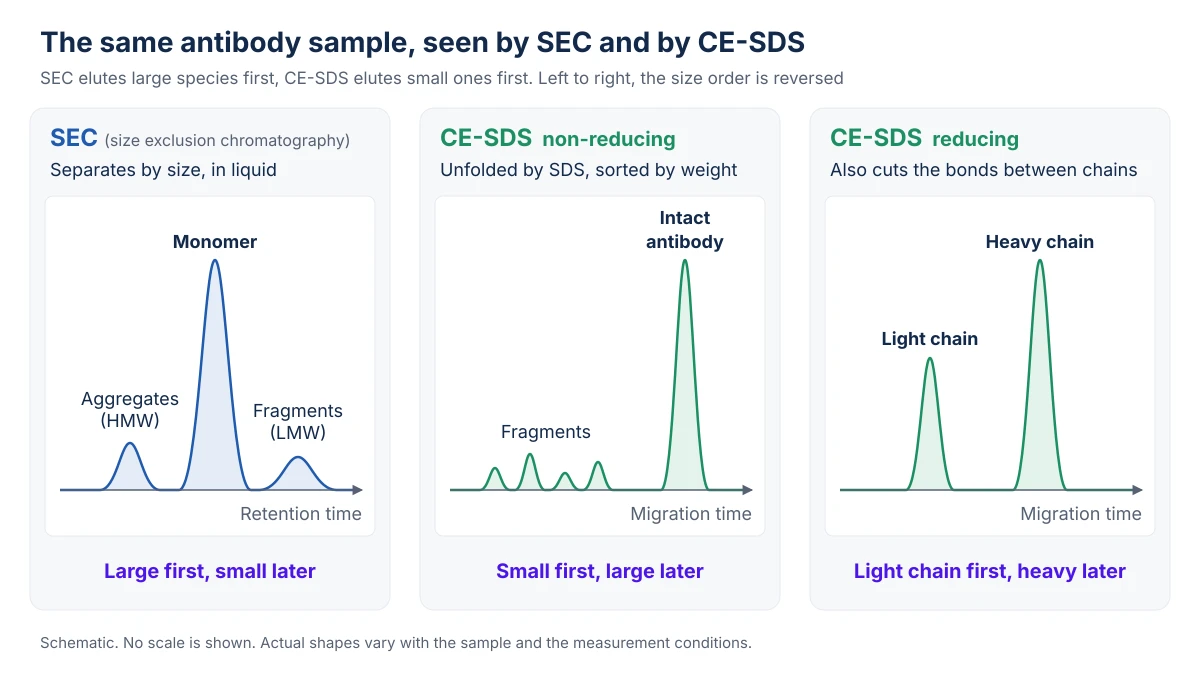
The peaks come out in different orders. In SEC, the aggregates come first, then the monomer, then the fragments. In CE-SDS without a reducing agent, the several small fragment peaks come first, followed by the large peak of the intact antibody, so the order is the reverse of SEC. Under reducing conditions, the light chain comes first and the heavy chain second.
Dynamic light scattering (DLS) and analytical ultracentrifugation (AUC) measure size or weight in solution by other principles, without passing the sample through a column. In development they serve to cross-check aggregates that SEC breaks up or loses. DLS has low resolution and weaker quantitation, and AUC takes a lot of effort. They are used for characterization during development and for method validation, while SEC and CE-SDS are the methods for release and stability testing.
When SEC and CE-SDS disagree, neither is necessarily wrong. SEC mostly tells you whether molecules are stuck together in liquid, and CE-SDS mostly tells you whether they are cut, so both values can be right at once. A regulator who had worked on monoclonal antibodies at FDA wrote in an industry magazine in 2008 that assessing aggregates takes several analytical methods. To confirm with light scattering whether an SEC peak is a dimer, see SEC-MALS (in Japanese). For a closer reading of CE-SDS results, see how to read CE-SDS (in Japanese). The choice among DLS, AUC and the rest is compared in which analysis to use for aggregates (in Japanese).
Particles that are invisible to the eye but far larger than one antibody (subvisible particles) can't be counted by SEC or by CE-SDS. For injections, the pharmacopoeial test for particulate matter (for example USP chapters 787 and 788) counts them separately. They appear in a different test result from purity, so check that both are in hand (subvisible particles (in Japanese)).
Don't conclude "purity is fine" from one method's number; read each value together with the method and what it saw.
Where aggregates form: purification, formulation and transport
The places where clumps form are fairly well known.
In purification, the usual suspects are the acidic condition used to release the antibody from Protein A chromatography, and the acidic hold that follows to inactivate virus. In an acidic liquid the antibody's shape loosens a little and it sticks more easily. In concentration by ultrafiltration (UF/DF (in Japanese)), the antibodies are pushed close together. Freezing and thawing the drug substance is another point where the antibody is easily damaged at the boundary with the ice (drug substance freeze-thaw (in Japanese)). All of these come after the culture ends, and in the flow of monoclonal antibody manufacturing they are scattered from Protein A capture through concentration to drug substance storage. How to hold them down in your own process is covered step by step in where antibody aggregation rises in the process (in Japanese).
Once the product is a formulated drug, you still can't relax. During transport, shaking can make the liquid foam, and at the boundary with air the antibody can denature. In prefilled syringes, the silicone oil coated on the inside of the barrel can seed clumps (aggregation in prefilled syringes (in Japanese)).
When you read the numbers, pay attention to where they were measured. The purity of the drug substance reflects how well the culture, purification and drug substance storage went. The purity of the drug product adds the formulation, the container and filling. If aggregates were low in the drug substance but have risen in the drug product, you can guess the cause lies after the drug substance: preparation, filtration and filling of the formulation, and then storage and transport. In stability testing, look not at a single value but at how fast the aggregates rise over time (ICH Q5C stability testing (in Japanese)).
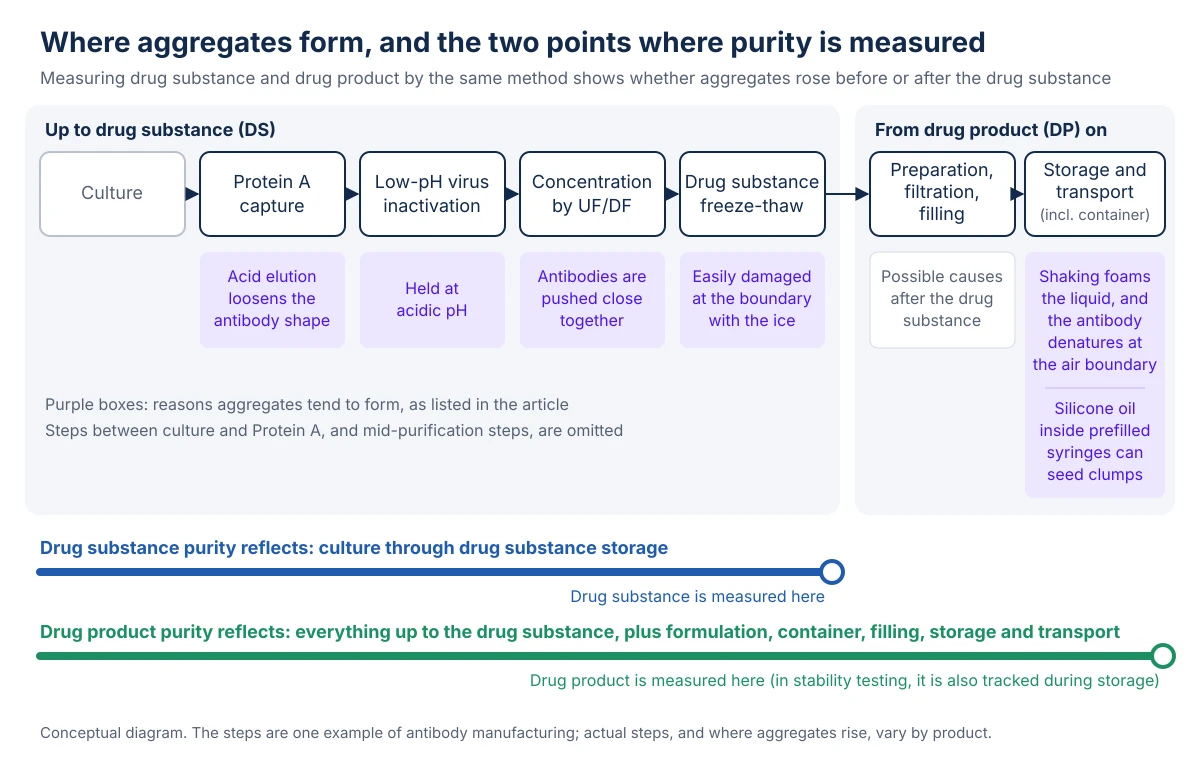
Narrow down where aggregates rose by measuring before and after a step with the same method.
Steps to check in a purity report
When you hold a purity report or a certificate of analysis, check these in order. They make it harder to misread what the number means.
- Find out whether "purity" is the SEC value or the CE-SDS value, and whether it is the percentage of monomer or of the main peak.
- Check whether the measurement used the same column, mobile phase and injection amount as the previous one.
- If the drug substance and the drug product differ, work out at which stage the aggregates rose.
- From how fast aggregates climb in stability testing, judge whether the lot is likely to stay within specification to the end of shelf life.
- Check whether subvisible particles are counted in a separate test from SEC.
Whether the testing goes to your in-house lab or to a contract testing lab, the questions are similar. Was CE-SDS measured under reducing or non-reducing conditions? Were the weak or very large aggregates that SEC can miss cross-checked by DLS or AUC during development? With those two answers, the scope of the number becomes clear.
For purchasing and analysis staff, the point to watch most is a change of column brand or measurement conditions. SEC values move with conditions, so before and after a switch the values may no longer compare directly with past data. If you change columns to cut cost or because of supply worries, measure the same samples with old and new in advance and put the change through change control (in Japanese). Candidate columns and instruments can be found in SEC-HPLC and CE-SDS systems.
Sources
- ICH Q6B: Specifications: Test Procedures and Acceptance Criteria for Biotechnological/Biological Products (Step 4, March 1999). ICH, Mar 1999.
- ICH Q5C: Quality of Biotechnological Products: Stability Testing of Biotechnological/Biological Products (Step 4, November 1995). The draft ICH Q1 revision published in April 2025 (Step 2) is meant to absorb Q5C; check ICH's website for its status. ICH, Nov 1995.
- Guidance for Industry: Immunogenicity Assessment for Therapeutic Protein Products (August 2014). FDA, Aug 2014.
- Aggregates in MAbs and Recombinant Therapeutic Proteins: A Regulatory Perspective (Cordoba-Rodriguez RV), BioPharm International 2008;21(11). BioPharm International, Nov 2008.
- Is any measurement method optimal for all aggregate sizes and types? (Philo JS), AAPS J 2006;8(3):E564-E571. AAPS Journal, 2006.
- Size-Exclusion Chromatography for the Analysis of Protein Biotherapeutics and their Aggregates (Hong P, Koza S, Bouvier ESP), J Liq Chromatogr Relat Technol 2012;35(20):2923-2950. Journal of Liquid Chromatography & Related Technologies, 2012.
- Thymoglobulin recall announcement (July 4, 2013). BASG (Austrian Federal Office for Safety in Health Care), Jul 2013.
- Batch recall of Thymoglobuline for IV Injection 25mg/5ml (July 2, 2013). Department of Health, Hong Kong SAR, Jul 2013.
- USP general chapters 129 (Analytical Procedures for Recombinant Therapeutic Monoclonal Antibodies), 787 (Subvisible Particulate Matter in Therapeutic Protein Injections) and 788 (Particulate Matter in Injections); paid compendia, check the current version in USP-NF. USP, Oct 2026.