Japan guide · Cell therapy process guide
CAR-T manufacturing process: apheresis to release testing
Photo: Chidera Faustina Okeke / Unsplash
In Kymriah's international ELIANA trial, 92 patients were enrolled and 75 received cells. The 17 who did not included patients who died or had adverse events while waiting, and cases where manufacturing failed and no product arrived. Before anyone could ask whether the drug works, there was an earlier wall: can it be made, and can it be made in time?
Most CAR-T therapies are autologous. You collect the patient's own T cells, insert a gene, expand them, freeze them and give them back. One patient is one batch, and the batch cannot go to anyone else. The condition of the starting material differs by patient, partly because of prior treatment. From collection to infusion takes around a month even for commercial products, and longer for some products and sites.
This guide follows the process in order and names the decision each group depends on. For manufacturing that is variability in the starting material and not over-expanding the cells. For purchasing it is the choice of activation reagents, media, devices and vectors. For QA it is a release decision that cannot wait for slow results, plus prevention of mix-ups.
Why is one patient, one batch so different from antibody manufacturing?
Antibodies are made as uniform lots in large bioreactors. CAR-T is made as one batch per patient. Facilities, records and the movement of people are all organized around that premise.
The metric the industry watches is vein-to-vein time: the total time from taking cells from the patient to returning them to the hospital in a state ready to infuse. For a patient whose disease is advancing quickly, a month is not short. The room to shorten it is often not in the manufacturing days. It lies in release testing and logistics on either side.
In CAR-T you build small, patient-specific batches, keep them sterile, and finish them in a short time, instead of making large uniform lots. Equipment selection and test design both work backward from that.
Work backward from a small, patient-specific, aseptic batch when you choose equipment and design tests.
Starting material sets the ceiling, so fix the receipt numbers first
The first step, apheresis, separates mononuclear cells from the patient's blood. The Spectra Optia system (Terumo BCT) is used with collection and transport bags (see apheresis and transport bags). Quality and quantity both vary by patient. If chemotherapy or steroids have depleted the lymphocytes, activation and expansion later will not go well. Tumor cells or granulocytes in the product also affect the steps that follow.
So set numbers at the point of receipt: cell count, viability and the fraction of T cells. An automated cell counter gives the count, and flow cytometry shows the composition. Managing this variability is covered in a separate guide on leukapheresis as starting material (in Japanese).
Fix numeric acceptance criteria for cell count, viability and T-cell fraction before the first patient's cells arrive.
Reagents and devices change the step count and the record volume, not just the speed
Selection and activation come next. Many processes use magnetic beads carrying anti-CD3 and anti-CD28 antibodies. The beads activate T cells by acting on receptors on their surface, and a magnet separates the target cells at the same time. With beads such as Dynabeads, a step to remove them magnetically is needed later in manufacture, and the residual amount is a specification item. TransAct (Miltenyi) is a reagent in which antibodies sit on a tiny polymer matrix. It is said not to need a bead-removal step, and it is used in closed automated manufacturing. Whether a removal step exists changes the number of steps and the volume of records.
Expansion brings the cells up to the dose in several days to about 10 days. A long culture exhausts cells and lowers potency. The optimum sits between expanding enough and not expanding too much. Culture runs in a closed system that never meets room air, and the flow path is single use, which prevents cross-contamination between patients by design. Typical choices are serum-free media for T cells and automated platforms such as CliniMACS Prodigy and Cocoon (Lonza). The benefit of a closed automated device is less about faster work than about fewer open manipulations, which lowers the cleanroom grade and the headcount you need. More on this is in closed, automated CAR-T manufacturing (in Japanese).
After expansion, residual medium and activation reagents are removed and the cells are moved into a cryopreservation medium, for example on a Lovo (Fresenius Kabi). They are then divided into containers such as cryovials and frozen at a controlled rate. At this step you check residuals and post-thaw viability. How to think about cryomedium and containers is covered in the guide to fill and cryoformulation for cell products (in Japanese).
Reagent and device choices differ less in speed than in how many things must be removed and how far the process can stay closed.
Gene transfer: virus or electroporation, and two safety numbers
There are two main ways to introduce the CAR gene.
One is a viral vector, either lentivirus or gamma-retrovirus. Most approved products use it. The gene integrates into the genome and expression is stable. The cost is that vector manufacturing often becomes the rate-limiting step, which is where cost and supply bottlenecks appear. The choice is laid out in CAR-T vector selection.
The other is non-viral transfer such as electroporation. It avoids virus manufacturing, so it can be faster and cheaper, but optimizing transfer conditions and keeping cells alive are the challenges. Practical details are in electroporation for cell therapy (in Japanese).
When a virus is used, safety is shown with two numbers. The first is VCN (vector copy number), the average number of CAR gene copies that entered the genome of one cell. More copies raise the risk of insertion at unintended places in the genome. A limit of "less than 5 copies per cell" has long been cited as a guide. FDA's final guidance of January 2024 takes the approach of setting the specification per product, based on risk assessment such as integration-site analysis. VCN moves with the method (qPCR or ddPCR, and which reference gene), so fix the method before you set a specification. See measuring VCN for CAR-T (in Japanese).
The second is RCL, the confirmation that no virus that has regained the ability to replicate is present. It is checked by viral safety testing, and the only acceptable answer is not detected. The approach is explained in replication-competent virus testing (in Japanese).
Set the VCN limit together with the method that measures it, and manage RCL as not detected.
Release testing sets the wait, and identity control prevents mix-ups
In CAR-T, the release tests are bound by time. The pharmacopoeial sterility test assumes 14 days of culture, and the culture method for mycoplasma takes several weeks. An autologous product for a patient who cannot wait cannot sit through that. Labs therefore use rapid methods such as rapid microbiological testing and nucleic acid amplification. A rapid method must be shown by validation to be equivalent to or better than the conventional method. The approach is in rapid release testing for cell therapy.
The second constraint is mix-ups. An autologous product's route splits by patient, and a mistake anywhere between collection and infusion means giving a different patient's cells. You need a design in which the Chain of Identity (who the patient is) and the Chain of Custody (where the specimen has been) stay unbroken in records and systems. See Chain of Identity and Chain of Custody (in Japanese).
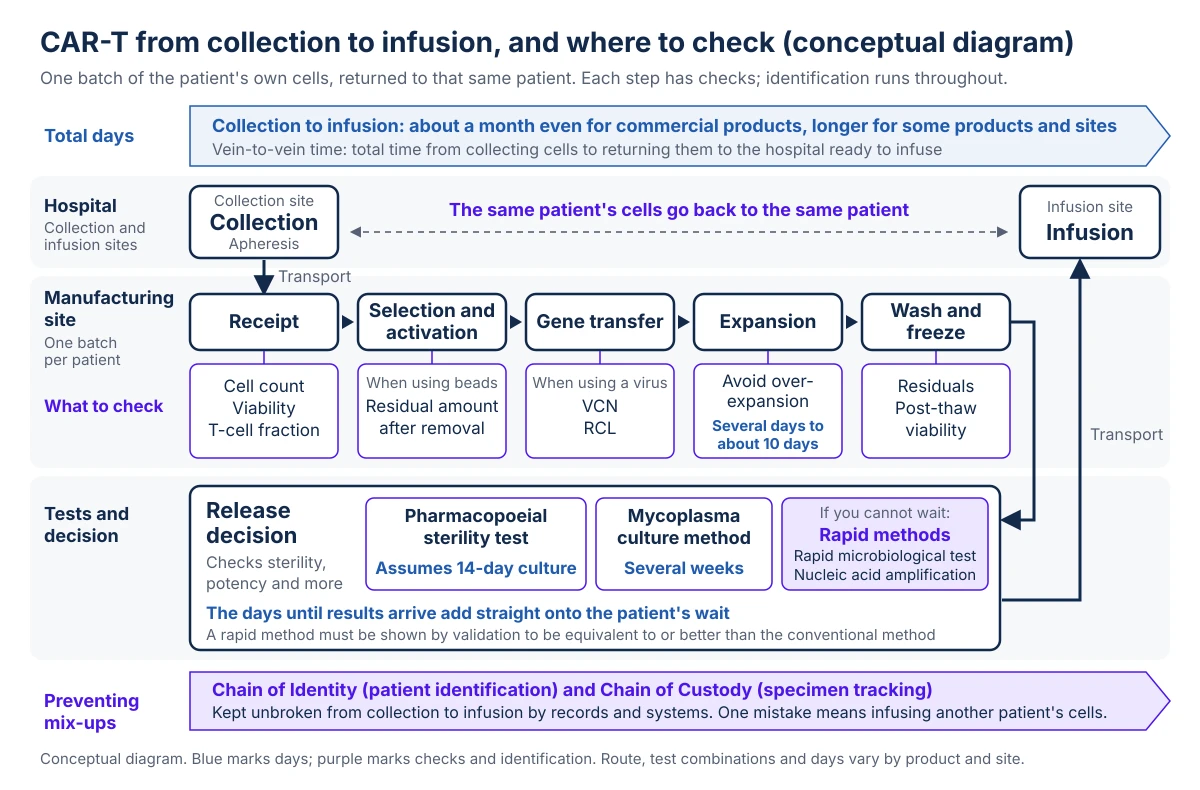
Shortening release testing by a day can matter more than shortening manufacturing by a day.
Where do CAR-T batches usually fail?
Failures line up in process order.
The first is the starting material. If prior treatment has depleted the cells, the batch may not reach the required number or may not expand, and that ends in a manufacturing failure. Decide the collection timing and the receipt criteria before manufacturing. One attempt to improve the starting material itself is to freeze cells while the patient is still healthy; a report of that approach is covered in banking CAR-T starting material while healthy (in Japanese).
The second is culture. Over-expansion exhausts the cells and lowers potency, while too little growth misses the specification. The two failures lie in opposite directions. A late vector delivery can also delay the start.
The third is waiting for release. Even if manufacturing ends on schedule, the days until test results arrive add straight onto the patient's wait.
Failures arrive in process order, so decide collection timing and receipt criteria first.
Eight checks to use in a quote request or a CDMO review
Before choosing equipment for your use, fix three things: receipt criteria, residue specifications and release-test days. That prevents a mismatch between quotations and the test plan. These items can go into a request for quotation or a specification review as they are.
- Have you set acceptance criteria for apheresis material (cell count, viability, T-cell fraction)?
- Does the activation reagent require bead removal? If so, is there a residual specification and a test method?
- Are the media and reagents GMP grade, and will the supplier notify you of changes?
- Are the vector supplier, the quantity and the split of VCN and RCL testing settled?
- Which steps still involve open manipulation, and what controls are layered on them?
- Do you use rapid methods for sterility and mycoplasma testing, and how far has validation gone?
- Are the post-thaw viability specification and the records of the route from freezing to infusion in place?
- Does the patient identification system run unbroken from the collection site to the infusion site?
Materials and equipment can be compared on the directory pages for apheresis and transport bags, T cell selection and activation reagents, T cell media, automated cell culture and electroporators. For testing, start with sterility testing and the cell therapy potency assay.
Three related guides answer the next questions. The difference from allogeneic CAR-T, which uses another person's cells, is in autologous vs allogeneic (in Japanese). The move toward making CAR-T inside the body is in in vivo CAR-T manufacturing (in Japanese). The product quality attributes are in cell therapy quality control (CQA) (in Japanese).
Sources
- Considerations for the Development of Chimeric Antigen Receptor (CAR) T Cell Products. FDA, Jan 2024.
- Chemistry, Manufacturing, and Control (CMC) Information for Human Gene Therapy Investigational New Drug Applications (INDs). FDA, Jan 2020.
- Guideline on quality, non-clinical and clinical aspects of medicinal products containing genetically modified cells (EMA/CAT/GTWP/671639/2008 Rev. 1). European Medicines Agency, Oct 2026.
- Tisagenlecleucel in Children and Young Adults with B-Cell Lymphoblastic Leukemia. The New England Journal of Medicine, Feb 2018.
- Global Manufacturing of CAR T Cell Therapy. Molecular Therapy Methods & Clinical Development, 2017.