Japan guide · Release testing
Cell therapy release testing: rapid sterility and mycoplasma
Photo: National Cancer Institute / Unsplash
Some cell therapy products reach the patient before the final sterility result is in. The protocol for a TIL therapy (lifileucel) clinical trial says so openly. At release, the in-process sterility test and Gram stain results are available. For a patient who needs treatment right away, the protocol judges that the benefit of dosing outweighs the risk of dosing before the final result. If a positive result comes later, the trial site must be told immediately.
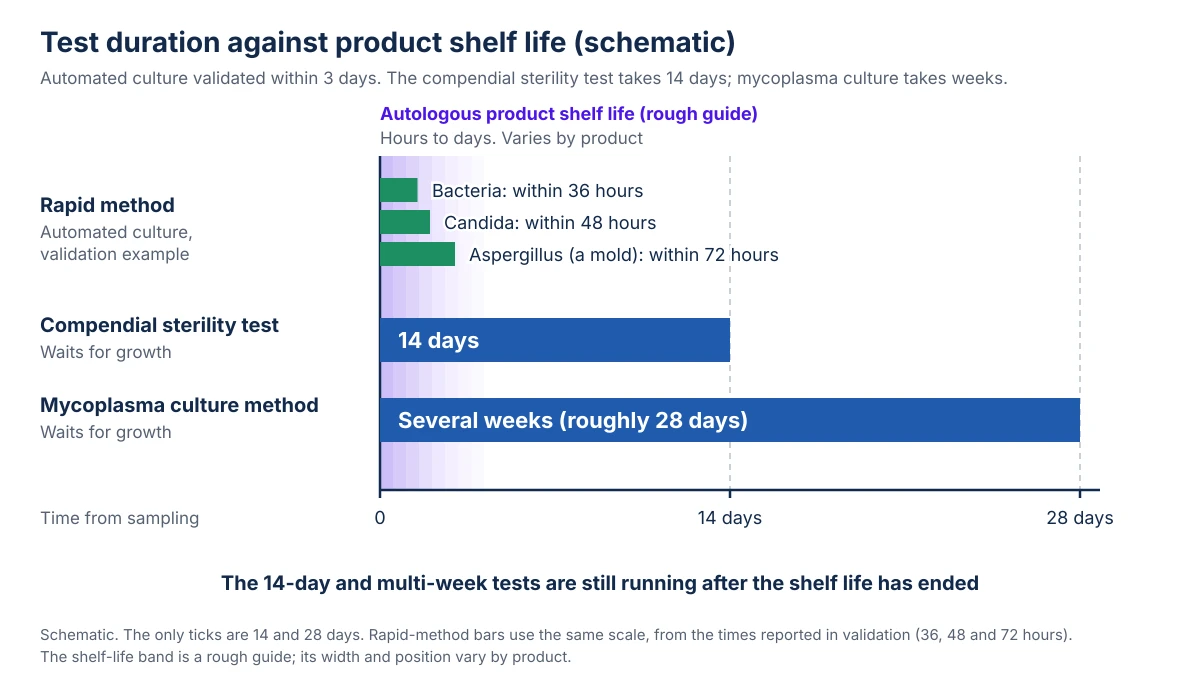
Two facts force this. Living cells cannot be sterile-filtered at the end, so sterility can only be confirmed by testing. And the pharmacopoeial sterility test takes 14 days while the mycoplasma culture method takes several weeks, both longer than the product's shelf life.
The answer is to replace slow tests with rapid methods and to move the tests that still cannot finish to after release. This guide covers what to speed up, what to defer, and who does what when a result turns positive. Quality assurance designs the release decision, purchasing chooses instruments and contract laboratories, and manufacturing decides how much sample can go to testing.
Release cannot wait for the compendial tests because shelf life is shorter
Whether you can wait for a release test depends on the product's shelf life.
A product with a stable drug substance or formulation, such as an antibody drug, can build a 14-day sterility test into the production schedule. Autologous products, made from the patient's own cells, cannot. They are made for one patient with a fixed dosing date, and the shelf life after manufacture runs from hours to days. Even for products stored frozen, the window from thaw to dosing is short, and a schedule built around the patient's condition is hard to move (CAR-T cell therapy manufacturing process).
Microbiological testing, by contrast, mostly works by growing the organism so you can find it. The pharmacopoeial sterility test (Japanese Pharmacopoeia general test 4.06, Ph. Eur. 2.6.1, USP <71>) inoculates the sample into culture medium, incubates for 14 days and confirms that nothing grows. The mycoplasma culture method takes several weeks, roughly 28 days, so that it also picks up slow-growing species (mycoplasma testing). Both tests wait for growth, and the days cannot be shortened.
The first design decision is the split: which tests become rapid methods, and which move to after release.
Four kinds of rapid method, and what each must prove
Rapid methods either shorten the wait for growth or skip it and detect the organism's components or genes directly.
Automated culture machines detect signs of growth before the culture turns visibly cloudy. Check the detection time for slow-growing yeasts and molds. Microcolony detection finds organisms by imaging or luminescence before colonies have grown. Check how much background a sample containing cells adds. ATP bioluminescence uses light to measure the ATP of living organisms. Check how it tells their ATP from the cells' own. Nucleic acid amplification tests (NAT), including qPCR, amplify genes without any culture. Check whether dead organisms are also picked up, and whether inhibitors in the sample interfere.
For sterility, automated culture such as bioMérieux's BacT/ALERT and microcolony detection such as Merck's Milliflex Rapid are in use. For mycoplasma, kits such as Thermo Fisher Scientific's MycoSEQ use real-time PCR (qPCR), a NAT that amplifies DNA so that it can be detected.
Automated culture has been validated on samples that contain cells. In a validation with a mesenchymal stem cell product, bottles spiked with a very small number of organisms (6) turned positive within 36 hours for bacteria, within 48 hours for Candida and within 72 hours for Aspergillus. The cells caused no delay in detection. Against 14 days that is far shorter. That the slowest is a mold is a caution when you choose a method. On a single time axis, those 36 to 72 hours fall within the hours-to-days shelf life of an autologous product, while the 14-day and 28-day tests run on after the shelf life has ended.
The pharmacopoeias have frameworks for alternative methods too. Ph. Eur. 2.6.27 is a chapter for cell-based products to which the sterility test (2.6.1) cannot be applied as written. USP <1071> covers rapid tests used to release sterile products with a short shelf life. Both assume the alternative is shown to be equivalent to, or better than, the compendial method (sterility testing and rapid microbiological methods).
A maker's published performance does not carry over to your product by itself, and a rapid method becomes usable only after you validate it on your own samples containing cells.
What happens when a positive result arrives after release?
Even with rapid methods, not every test finishes before release.
Confirmatory sterility culture is one example. Another is the long-term tumorigenicity evaluation of products derived from pluripotent stem cells such as iPS cells. Both cannot finish in time for dosing. So products are released conditionally, on the rapid-method results plus evidence from aseptic processing, environmental monitoring and raw material control, and the confirmed results are checked afterward.
What if a positive result comes later? The protocol of a CAR-T trial shows the flow. The microbiology laboratory notifies the treating physician immediately. The physician informs the patient, runs tests for infection and starts antibiotics if needed. At the same time, the event is reported to the committee that evaluates safety, to the institutional review board and to FDA. The protocol of a regulatory T cell (Treg) trial goes further and says that when a positive result comes after release, patient enrollment may be paused until the cause is identified and corrected.
Commercial products need the same items to be decided: whom to contact, how quickly, how the patient is evaluated, how the cause is investigated and corrected (CAPA), and how the regulator is told. Put in writing, between the manufacturer and the hospital, who tells whom what, within how many hours.
Conditional release works only if the response to a later positive has already been decided.
The release decision works backward from the limits of autologous products
Release is not a single pass/fail line. It is a design: which tests sit before release, which become rapid methods, which move to after release, decided product by product.
The foundation is the critical quality attributes (CQAs): identity, purity, potency and safety. What you measure, and how far each measurement is tied to the release decision, is worked out backward from them (CQAs of cell therapy (in Japanese)). For potency, the issue is which reproducible surrogate with a short turnaround to use as a release test. In TIL therapy, potency testing became a point of debate in the approval review (potency testing for cell therapy (in Japanese), TIL therapy manufacturing (in Japanese)).
The rule of one lot for one patient narrows the design further. A limited product leaves little sample for testing, and if a lot fails you cannot simply remake it. A rapid method that works on a small sample gains value for that reason. Mix-ups are fatal too, so a record that ties the patient uniquely to the product from collection to dosing, the chain of identity, is required together with the release decision (chain of identity and chain of custody (in Japanese)).
Shelf life, sample volume and mix-up prevention set the number and kind of tests you can place before release.
Steps for choosing test methods, contract labs and hospital agreements
Use these in method selection, in contracts with testing laboratories, and in agreements with hospitals.
- Make one list that sets each test's turnaround next to the product's shelf life, including the period after thaw.
- For each rapid method, confirm that validation on your own samples containing cells and a comparison with the compendial method are done. Treat the maker's validation package and your own product's validation as two separate things.
- Check the detection time for slow organisms such as yeasts and molds. For NAT, decide how dead organisms are handled.
- Check that the sample volume available for testing covers every test you need.
- Agree with the hospital in writing on whom to contact, how quickly, how the patient is evaluated, how the cause is investigated and how the regulator is told when a positive arrives after release.
- For a contract testing laboratory, confirm the days to result, weekend and holiday coverage, the sample hand-off and the report format.
- When switching from a compendial method to a rapid method, plan a parallel testing period and a change control procedure.
If you sell into this field, be ready to answer which products you have validation data for on samples containing cells. That is the premise of any proposal.
Product entry points are the directory pages for sterility tests, mycoplasma tests, real-time PCR instruments and cell therapy potency and function assays. To follow the flow from manufacturing to dosing, continue with closed-system cell manufacturing and cryopreservation and logistics for cell therapy (in Japanese).
Sources
- Study of Lifileucel (LN-144), Autologous Tumor Infiltrating Lymphocytes, in the Treatment of Patients With Metastatic Melanoma (NCT02360579): protocol. ClinicalTrials.gov, Oct 2026.
- PSCA-CAR T Cells in Treating Patients With PSCA+ Metastatic Castration Resistant Prostate Cancer (NCT03873805): protocol. ClinicalTrials.gov, Oct 2026.
- Study of CAR-20/19-T Cells in Patients With Relapsed Refractory B Cell (NCT03019055): protocol. ClinicalTrials.gov, Oct 2026.
- Polyclonal Regulatory T Cells (PolyTregs) for Pemphigus (NCT03239470): protocol. ClinicalTrials.gov, Oct 2026.
- European Pharmacopoeia - Chapter 2.6.27 Microbiological Examination of cell-based Preparations revised. GMP-Compliance.org, Oct 2026.
- Validation of the automated BacT/ALERT system in the microbiological control of advanced therapy cell products (Spanish). Actualidad Médica (Ruiz García et al.), 2016.
- European Pharmacopoeia: Ph. Eur. 2.6.1 Sterility, 2.6.7 Mycoplasmas, 2.6.27 Microbiological examination of cell-based preparations, 5.1.6 Alternative methods for control of microbiological quality. EDQM, Oct 2026.
- USP <71> Sterility Tests, <63> Mycoplasma Tests, <1071> Rapid Microbial Tests for Release of Sterile Short-Life Products, <1223> Validation of Alternative Microbiological Methods. USP, Oct 2026.
- ICH Q2(R2) Validation of Analytical Procedures. ICH, Nov 2023.