Japan guide · Closed-system manufacturing
Closed-system cell manufacturing: what counts as closed
Photo: Logan Voss / Unsplash
Sartorius announced Eveo, an integrated platform for autologous cell therapy, in March 2026, and it sold itself on room use, not on sterility. By running several batches in parallel, the company says, one operator can process eight patients' batches at the same time in a cleanroom normally sized for two. Trial runs with CDMOs including ElevateBio are reported to have worked as designed, but no measured values were shown.
Closed systems are usually explained as a way to prevent contamination. On the floor, what also pays off is the loosening of limits on staff and rooms. A closed system (閉鎖系) joins the process steps with equipment and sterile connections so that cells never meet room air. Cell therapy products can be neither heat sterilized nor sterile filtered, so sterility has to be protected while the product is made, and the surest way is for people to open containers less often. Yet a catalog that says "closed" does not tell you how far the closure goes. That differs from device to device.
For manufacturing, the question is how to count open steps. For purchasing, it is the supply of disposable sets and connection parts. For quality assurance, it is how to show that a process is closed. If you sell into this field, asking a customer which steps are still open shows you where the proposal should go.
Why close the process: the product cannot be sterilized at the end
Small-molecule drugs and biologics can be made sterile in the last step. Cell therapy has no such step.
Heat and radiation destroy the cells that are the active ingredient, and sterilizing filters do not let cells through. So every step from collection through activation, gene transfer, culture, washing, concentration and filling is joined under aseptic conditions, and sterility is kept by never letting microorganisms in from outside. The final sterility test takes about 14 days, and some products are dosed without waiting for the result (release testing for cell therapy). A design that finds contamination later and removes it does not work.
With autologous products, which use the patient's own cells, one batch serves one patient. If contamination appears midway, there is no replacement material, and the chance to dose is lost (autologous and allogeneic cell therapy (in Japanese)).
That is why reducing the opening of containers matters. People are one of the main sources of contamination in aseptic work. Technique takes time to master, and differences between operators translate directly into quality risk.
A closed system drops the design of finding and removing contamination and cuts the chances of contamination getting in at all.
Three forms of closed: integrated devices, connected containers and open handling
"Closed" in a catalog does not mean the same boundary everywhere. Sorting products into three forms makes them easier to compare.
An integrated device puts most of the process inside a disposable flow path (tubing, bags, cartridges) and runs all or part of selection, gene transfer, culture and harvest automatically. Examples are CliniMACS Prodigy (Miltenyi Biotec), Cocoon (Lonza) and Quantum (Terumo BCT). Check the joints with the outside world and the scale one unit can handle. Miltenyi Biotec's CliniMACS Prodigy runs magnetic cell selection, gene transfer, culture and harvest within a single disposable tubing set, and a 2018 report (Zhu et al.) describes making CAR-T cells with it at a university hospital cell manufacturing facility. Its uses are covered in closed, automated CAR-T manufacturing (in Japanese). Terumo BCT's Quantum is a bioreactor built on hollow fibers, bundles of thin tubes, and it handles expansion. Medium exchange during culture runs on pumps and valves inside the unit, so the occasions for opening a container drop sharply.
The second form is joining closed containers to each other. Sterile connectors or tube welders connect them aseptically, which is sometimes called functionally closed. Examples are AseptiQuik (CPC), Opta SFT (Sartorius) and TSCD-II (Terumo BCT). The connection itself is a human operation, so check the procedure and the training.
Outside any device, connections always appear. You connect bags of raw material, add medium, pull samples and move the finished cells into a freezing bag. If these become open handling, closing the device loses most of its point. What you use here are sterile connectors and tube welders, which melt tubes together with heat. A connector such as CPC's AseptiQuik is a part the maker says allows aseptic connection even in a non-sterile environment. To seal a used flow path with heat and cut it off, you use a sealer such as Sartorius's BioSealer. The choice between them is laid out in how to choose between sterile connectors and tube welders (in Japanese).
The third form is where open handling remains. A person opens containers inside a biosafety cabinet, in which airflow protects operator and product, or an isolator, an isolated space worked through gloves. In a cabinet, sterility depends on the operator's movements. An isolator works in a decontaminated enclosure, so it depends less on people (aseptic processing (in Japanese)). Check the operator's technique and the grade of the room outside.
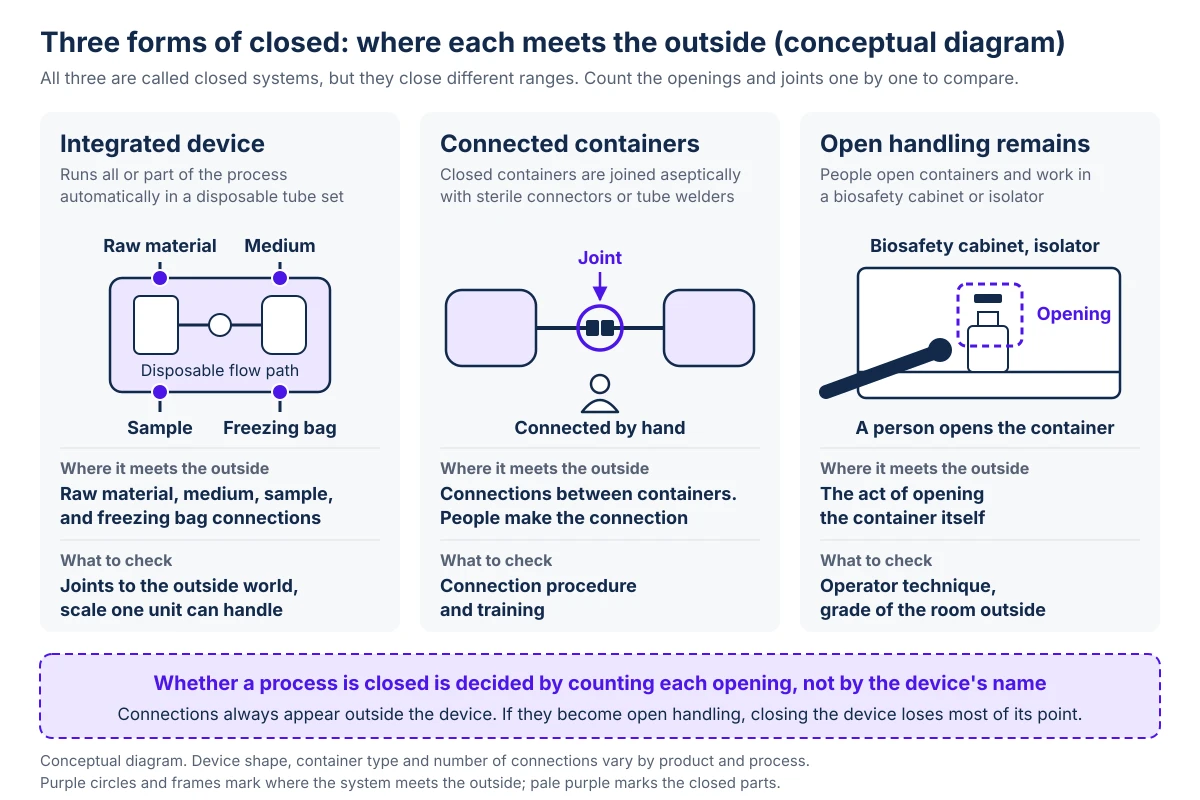
Whether a process is closed is decided not by the device's name but by counting each opening on the process diagram.
What closing changes: contamination, people and rooms
The effects show up in three directions: contamination, people and rooms.
Contamination first. The more often containers are opened, the more chances there are, so fewer open steps means fewer chances. You show the validity of aseptic operation with a media fill test (培地充填試験), a simulation that runs growth medium in place of product and checks that no contamination appears during the operation. A closed process has fewer open steps to reproduce.
For people, technique is replaced by machine action. A device repeats the same motion according to its recipe, which reduces differences between operators and lightens qualification of staff. People still load the disposable set, make the connector joints and run the welder, so training does not go away.
Cleaning changes too. A disposable flow path is replaced with a new one for every lot, so there is no need to verify cleaning that removes the previous lot's residue (line clearance (in Japanese)). For autologous manufacturing, where each patient's product differs, this lowers concern about mix-ups and carryover. In exchange, you verify leachables from the disposable materials and the stability of set supply.
Rooms are where the change can be largest. If you can show that the process is closed, you can consider revisiting the cleanliness grade required for the room around the equipment. Sartorius says Eveo can run in a lower-grade environment. But the grade decision rests on a risk assessment for each process and on agreement with the regulator, and a device maker cannot decide it. In Japan, regenerative medical products are made under the GCTP Ministerial Ordinance (GCTP省令), which requires the cleanliness classification, pressure differentials and the flow of people and materials as facility requirements.
Measure the benefit of closing by the number of open steps you removed and by how much lighter the load on people and rooms became.
Where do closed-system projects go wrong?
Projects stumble outside the device more often than inside it.
First, uncounted openings. Teams look only inside the device and do not count outside it. Raw material input, medium additions, sampling and final filling all count, plus one that is easy to miss: the procedure for when something goes wrong. It does not appear in the normal process diagram, so it turns up later as extra open handling.
Second, treating the joints lightly. The number of connection points equals the number of contamination opportunities. Connections are made by hand, so they need procedures and training. A pre-assembled, sterilized single-use assembly cuts the number of joints made on site at the design stage.
Third, the shortcut "it is closed, so the room grade does not matter." To lower the grade you need the grounds for closure and demonstrations such as media fills. The evidence that a process is closed is the media fill result, not the device's specification sheet. If the grounds are weak, treat the step as an open process and think about the room grade accordingly.
Fourth, applying a maker's numbers to your own case. Eveo's "eight patients" is the design capacity for parallel operation, and the trial runs with ElevateBio and others are described only as having worked as designed. "From floor area for 100 runs a year to more than 350" is the company's estimate, assuming about 7 days per batch and 50 operating weeks a year. "About 90% lower manufacturing cost" (for a CAR-T process) is the result of a separate financial model. Use such figures only after you check them with your own cells, your own process and your own headcount.
Fifth, estimating the number of units. Many integrated devices make one patient's dose per run, so capacity is set by the number of units and the number of rooms. Configurations like Eveo's, which run several batches in parallel, appeared to remove that limit. Work backward from the patient numbers and estimate units, rooms and staff first.
Sixth, later equipment changes. Moving from manual work to an automated device, or changing models, is a manufacturing change. You need a comparison showing the product is made with the same quality before and after, and for autologous products, where a reference lot cannot be kept, designing that evaluation is harder (comparability for autologous cell therapy (in Japanese)). Looking at how easily the equipment can be swapped later, at the time of purchase, saves trouble.
Closed-system failures come less from lack of device performance than from missed counts and assumptions.
Checks to run before you buy a closed system
Use these in equipment selection and when comparing contract manufacturers.
- Have you written down every operation in your current process that opens a container, including sampling, raw material input, medium addition, filling and the procedure when something goes wrong?
- Can the candidate device's maker show, in a diagram, where it is closed and where it opens?
- Are connections made by connector or by welding, and are there a written procedure and a qualification of operators for that operation?
- Can the media fill test be designed to include the connections and the sampling operations?
- Working backward from patient numbers, are the units, rooms and operators you need enough?
- Will the maker supply the disposable sets, state the sterilization method and provide leachables data?
- How will you treat the grade of the surrounding room, and how will you explain it to the regulator?
- Can you plan change control and a comparability assessment for the day you replace the device?
Equipment lists are in the directory pages for automated cell culture systems and aseptic connectors and tubing. Related questions have their own articles. For washing and concentrating cells in the middle of a closed process, see cell washing and concentration technology (in Japanese). For the tests that release a product made in a closed system quickly, see release testing for cell therapy. For the process as a whole, see CAR-T cell therapy manufacturing.
Sources
- Sartorius Launches Next-Generation Platform to Boost Efficiency in Cell Therapy Production. Sartorius, Mar 2026.
- Closed-system manufacturing of CD19 and dual-targeted CD20/19 chimeric antigen receptor T cells using the CliniMACS Prodigy device at an academic medical center. Cytotherapy (Zhu et al.), Mar 2018.
- Automated manufacturing of chimeric antigen receptor T cells for adoptive immunotherapy using CliniMACS prodigy. Cytotherapy (Mock et al.), Aug 2016.
- Global Manufacturing of CAR T Cell Therapy. Molecular Therapy Methods & Clinical Development (Levine et al.), Mar 2017.
- Guidelines on Good Manufacturing Practice specific to Advanced Therapy Medicinal Products (EudraLex Volume 4, Part IV). European Commission, Nov 2017.