Japan guide · Ion exchange resins
Ion exchange resin selection: reading CEX and AEX capacity

Photo: Logan Voss / Unsplash
Tosoh's catalog entry for TOYOPEARL GigaCap Q-650M gives two capacities. With bovine serum albumin (BSA) it is about 175 mg/mL. With thyroglobulin, a far larger protein, it is about 49 mg/mL. Same resin, and the capacity drops to less than a third when the molecule being loaded changes.
When people pick an ion exchange resin, most start by comparing the dynamic binding capacity (DBC) in the catalog: how much one milliliter of resin captures while the liquid is flowing. But that number is not a property of the resin alone. It can double or halve depending on what you load, at what leakage you stop counting, and how fast you pump. Size the column from the size of the number and you may come up short later.
This guide is for people who buy, sell or QA-check resin lots, and it shows how to read the numbers with their conditions. Beyond capacity, the base material, the bead size, the ligand and the number of cleaning cycles the resin survives give you reasons you can defend when you choose.
Which impurity sits on which side of the antibody's isoelectric point?
Ion exchange resins separate antibody from impurities by the difference in electric charge that proteins carry. In antibody purification the usual place for them is the finishing (polishing) stage after Protein A capture, and cation exchange (CEX) and anion exchange (AEX) take different jobs.
CEX is mostly run in bind-elute mode. The positively charged antibody is first attached to the resin and then released with salt or a change in pH. This separates aggregates and charge variants, antibodies that differ in charge. AEX is normally run in flow-through mode, where the antibody passes straight through. Negatively charged host cell protein (HCP), DNA, endotoxin and virus stick to the resin and are removed.
Which one goes first, or whether you need both, depends on which side of the antibody's isoelectric point (pI, the pH at which its net charge is zero) the impurities you want to remove sit. How to choose between the two modes is covered in CEX bind-elute versus flow-through (in Japanese) and antibody purification polishing (in Japanese). If ion exchange alone does not remove aggregates, the next option is mixed-mode chromatography (in Japanese).
Decide CEX, AEX or both from the pI of your antibody and the side of it on which your target impurities sit.
Capacity is not fixed: it changes with what you flow
DBC is not a fixed value of a resin.
You keep loading the column, and DBC is the amount the resin has captured by the time the target protein shows up at the outlet at a chosen fraction of the inlet. Whether you end at 5% or at 10% leakage (the breakthrough percentage) changes the value. So does the flow rate, which is the residence time.
Plotted as outlet fraction against volume loaded, the breakthrough curve rises in an S shape. Reading it at 10% lands farther along the volume axis than reading it at 5%, so DBC comes out a little larger. A larger analyte or a faster flow shifts the whole curve to the left and lowers DBC.
Thermo Fisher publishes more than 100 mg/mL for POROS XS at 5% breakthrough. Cytiva gives more than 55 mg/mL of BSA for Capto Q ImpRes at 10% breakthrough and a 4-minute residence time. The breakthrough percentage, the residence time and the protein all differ, so you can't say which of the two numbers is larger.
The effect of the protein is what the GigaCap Q-650M example at the top shows. A large molecule can't get deep into the pores of the resin, so capacity falls. Catalog values are usually measured with an easy model protein such as BSA or lysozyme. Your antibody has a different size and a different pI.
So don't ask a supplier "What is the DBC?" Ask: "What is the capacity if I run my antibody at this breakthrough percentage and this residence time?" Once you are down to two or three candidates, measure breakthrough curves with your own molecule. That keeps you from sizing the column wrong. How to measure is in measuring Protein A resin dynamic binding capacity (in Japanese), and the overall approach to choosing resins is in how to choose purification resins.
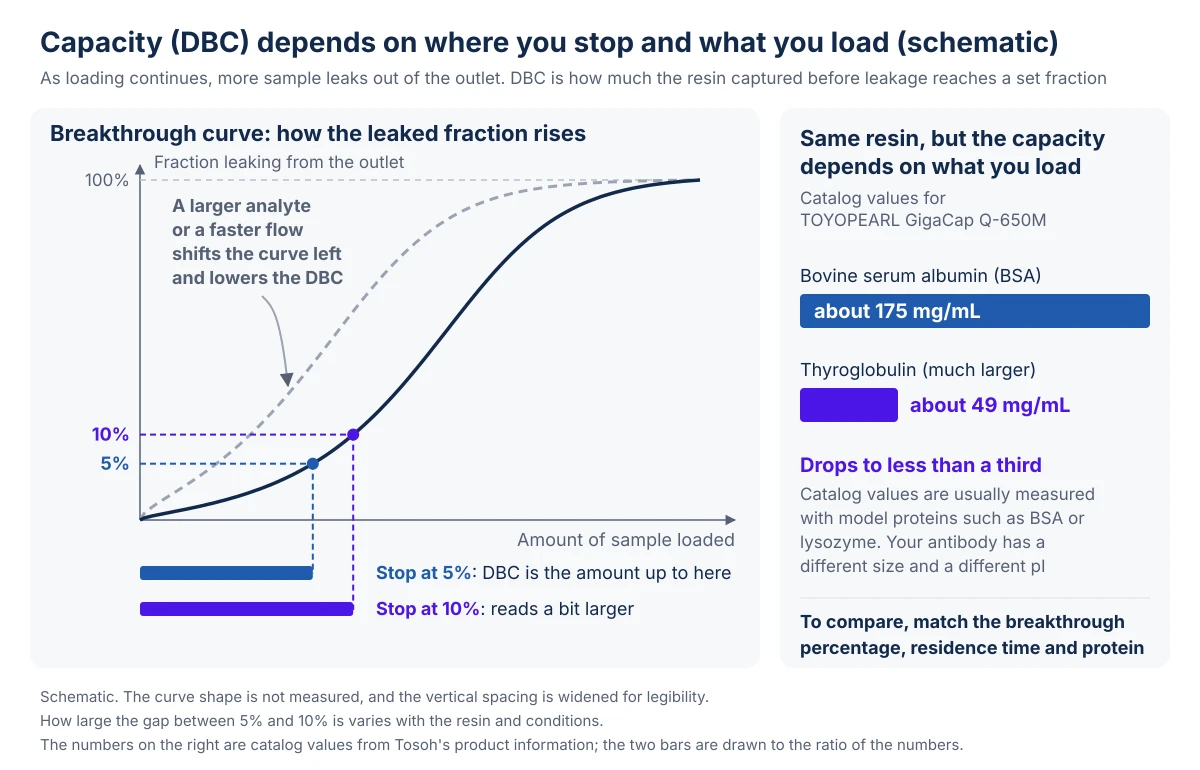
DBC can be compared only when the breakthrough percentage, the residence time and the protein loaded are matched, and arguing about which number is bigger before that gets the column estimate wrong.
Base matrix, bead size and ligand pull capacity, resolution and pressure apart
The main axis for choosing is the base matrix and the particle size, before the ligand (the exchange group).
The base material decides whether you give priority to capacity, resolution or backpressure, the pressure inside the column when liquid is pumped through.
Highly cross-linked agarose is the soft one. It tolerates pressure less, so the beads are made larger to gain flow rate, which gives high flow with low backpressure. Capto Q, at 90 µm, is an example. Some of these resins tolerate 1 M sodium hydroxide, such as Capto S ImpAct.
Methacrylate polymer has a rigid backbone, so capacity holds up even at a high linear velocity (how fast the liquid moves through the bed). Tosoh's GigaCap resins take 0.5 to 1 M sodium hydroxide for cleaning. For Merck's Fractogel EMD, 0.1 to 0.5 M is the standard and 1 M is allowed for short exposure. GigaCap Q-650M, at 75 µm, is an example.
Polystyrene-divinylbenzene is the most rigid, and it withstands high flow even with small beads. POROS XQ, at 50 µm, is an example. For its alkaline tolerance, check each supplier's documents.
Bead size carries the trade-off between resolution and processing speed directly. A smaller bead shortens the distance a molecule must diffuse inside the resin and sharpens the peaks. Capto Q ImpRes keeps the chemistry of Capto Q (90 µm) but packs beads of about 40 µm, and gives a separation suited to polishing. Tosoh offers Q-650S at 35 µm against the 75 µm of GigaCap Q-650M. The price of smaller beads is higher backpressure at the same flow, so processing slows. If you take resolution, you pay for it in pressure.
How the ligand is attached changes how well large molecules reach it. When ligands sit directly on the resin surface, big molecules like antibodies have trouble getting in. Merck's Fractogel EMD places the ligand at the end of polymer chains, called tentacles. The chains flex, so even large molecules reach the binding points.
The other axis is strong versus weak exchange groups. Sulfonic acid groups (strong CEX) and quaternary ammonium groups (strong AEX) keep their charge over a wide pH range. POROS XS, GigaCap S and Q, and Capto Q all use strong groups. Carboxymethyl groups (weak CEX) and diethylaminoethyl groups (weak AEX) change their degree of dissociation with pH, which helps when you want to tune selectivity finely by moving the pH. Strong groups are the starting point for basic capture, and weak groups for building a separation.
Choosing a fine-bead resin on capacity alone can leave you unable to pump it because of the backpressure.
The base sets the pressure ceiling and the usable linear velocity, and within that ceiling bead size decides whether you buy resolution or throughput.
Cleaning cycles decide what a resin really costs
A resin's life depends less on how large its capacity is than on how well it withstands cleaning in place (CIP).
In manufacturing, the same column is used dozens of times. Each time it is washed with sodium hydroxide to remove protein and endotoxin left by the previous lot. How many of these washes the resin survives turns the purchase price into a real cost. As the base material discussion above shows, the strength it tolerates differs by base and by product. Cytiva's Capto S ImpAct tolerates 1 M sodium hydroxide and can be used at pH 4 to 12, and the company reports that after a week in 1 M at 40°C, its ion capacity and carbon content showed no notable change. Weak exchange groups tend to lose more capacity in cleaning than strong ones.
Published alkaline tolerance is usually the capacity after soaking at one concentration for one time. In a real process, it is the combination of concentration, contact time and number of cycles that counts. At the same 1 M, 30 minutes per cycle versus 15 minutes doubles the accumulated load. Stronger cleaning removes soil better, but for some resins it erodes binding capacity. Before you raise the concentration, measure capacity and find out how many cycles that resin survives under your conditions.
The mistakes made at the plant follow a few set patterns. The catalog DBCs are lined up from largest to smallest and one is chosen, and when measured with the plant's own antibody it falls short. A small-bead resin is chosen on capacity alone, backpressure rises and the flow rate can't be reached. Conditions that worked on a small column are applied unchanged to a large one. The cleaning concentration is raised without remeasuring capacity. A resin is swapped, and only afterward does the team find that it has to show the product is comparable before and after.
How things break down when you go from a small column to manufacturing scale is covered in chromatography scale-up (in Japanese), and the column structure and what to look for when buying are in choosing chromatography column hardware (in Japanese).
Estimate a resin's real cost and replacement timing from how many cycles it survives under your own CIP conditions, not from its unit price.
Steps to settle before you choose a resin
Decide these in order before you pick a resin.
- Decide what the step removes. If you are separating aggregates or charge variants, CEX in bind-elute mode. If you are removing HCP and DNA together, AEX in flow-through mode.
- Get the antibody's pI and the pH and conductivity of the load, and decide whether you want it to bind or pass through.
- Run your own antibody on the candidate resins, and measure capacity at the breakthrough percentage and residence time you will use.
- Choose the base and bead size from the backpressure your column can take and the resolution you need: large-bead agarose if flow rate comes first, small beads if separation does.
- Choose the strength of the exchange group, and whether you want tentacles, from the size of the molecule and the selectivity you want to build.
- Work out how many cycles the resin can take under your own CIP conditions, and how many cycles per year you expect to run.
A supplier's values narrow the candidates. The data you take with your own antibody make the decision.
Products can be compared in AEX resins, alongside CEX resins. If you are considering a single-use adsorptive membrane in place of a resin, see what is membrane chromatography (in Japanese).
Sources
- TOYOPEARL GigaCap Q-650M product information. Tosoh Bioscience, Oct 2026.
- POROS XS Strong Cation Exchange Resin. Thermo Fisher Scientific, Oct 2026.
- Fractogel EMD SO3- (M) product information. Merck, Oct 2026.
- Capto Q ImpRes Data File. Cytiva, Oct 2026.