Japan guide · Virus filter membranes
Virus filter selection: membrane material, structure and LRV
Photo: Google DeepMind / Unsplash
Line up the catalogs of virus removal filters and the numbers are almost the same from every supplier: a pore size around 20 nm and parvovirus removal of 4 log or more. So why do so many different products stay in use?
The difference is not the power to stop the virus. It is the membrane material and the layer structure. The material decides how much of your target protein passes through without loss and how much volume you can filter. The structure decides whether the membrane keeps the virus it has captured from escaping downstream after the pump stops and the pressure drops.
Lost recovery hits yield. Clogging hits process time and extra filters. Behavior at an interruption hits validation and deviation handling. That is why a buyer comparing quotes and a QA reviewer reading a report can't decide on pore size and LRV alone. This guide shows what else to compare, and what to ask the supplier.
What does a virus filter stop, and what must it let through?
A virus removal filter sits late in purification. It is a membrane with pores a few tens of nanometers across, and it stops virus physically by size while letting the target protein, such as an antibody, pass.
It also works on small parvovirus (18 to 26 nm), which low-pH virus inactivation handles poorly, so it is used in combination with inactivation.
Removal performance is expressed as the log reduction value (LRV): how many orders of magnitude the virus count fell. An LRV of 4 means one ten-thousandth. ICH Q5A(R2) was finalized in November 2023, and it takes the approach of reducing virus in several steps so that the whole process carries a margin. The overall picture is in what is virus filtration (in Japanese) and in how to read a viral clearance report (in Japanese).
Treat the filter as one of several steps, with the specific job of removing by size what inactivation handles poorly.
Three membrane materials: cellulose, PVDF and PES
Membrane materials fall into three families. The axes for choosing are how little of your target protein the membrane loses, and how much volume it can process.
Regenerated cellulose is the base of Asahi Kasei's Planova 15N and 20N, hollow fibers of cellulose regenerated by the cuprammonium process. The membrane itself is water-friendly (hydrophilic), so proteins stick less, and recovery is said to hold even for large plasma-derived proteins. The 20N in the name is a pore size class, and the measured mean pore size is about 19 nm. Read pore size numbers as names, separate from measured values. Before choosing, check recovery and throughput in your own liquid.
PVDF is the material of Asahi Kasei's Planova BioEX and Merck's Viresolve NFP. BioEX uses hydrophilized PVDF hollow fibers in place of cellulose. This family aims at liquids that are concentrated and prone to clogging. Check throughput and the pressure range in your own liquid.
PES is the family of Merck's Viresolve Pro and Sartorius's Virosart CPV and HF, where the suppliers put flow rate and throughput forward. If your liquid clogs, check whether you need a prefilter.
At the plant, the material shows up as yield and time. With an expensive target, a small loss adds up to lost yield. If throughput falls short, you add membrane area or add filters to get through the same lot.
Materials are leanings, not a ranking: consider regenerated cellulose or PVDF for large molecules that adsorb easily and PES when you need to push a large volume, then compare recovery and throughput in your own liquid.
What happens to captured virus when the pressure drops?
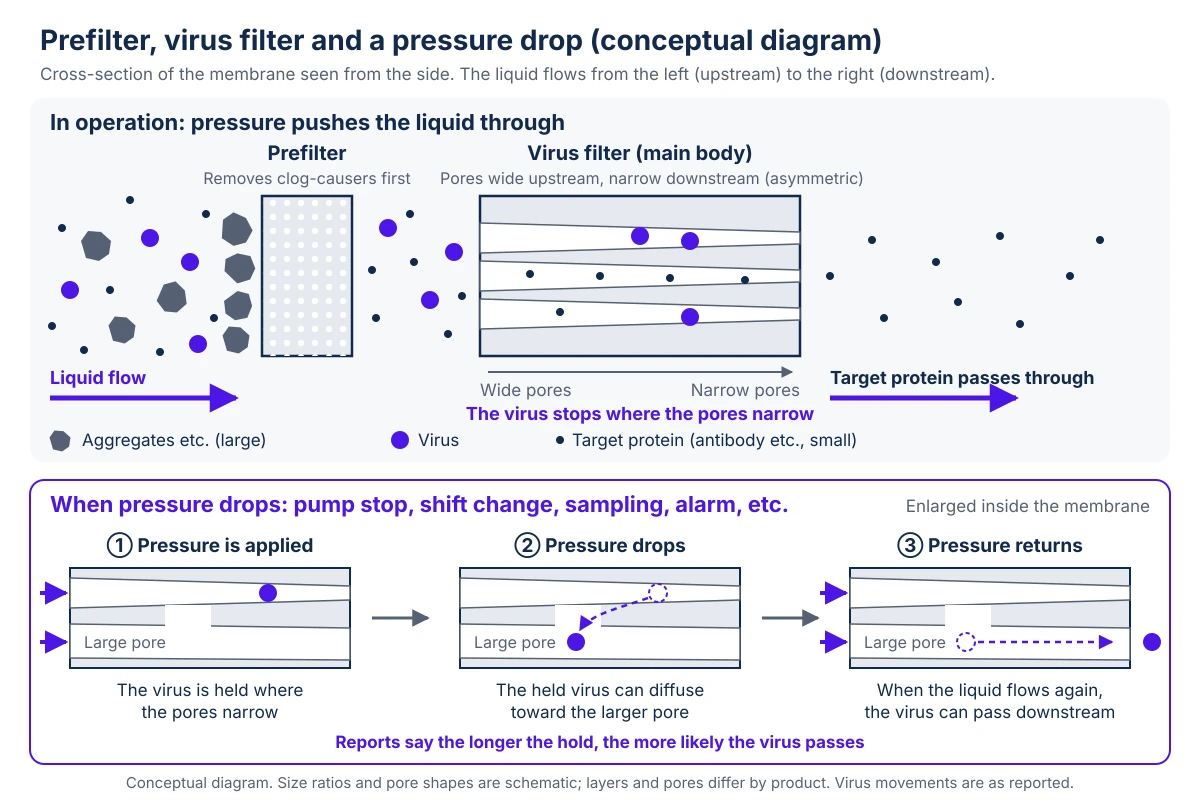
A virus filter is run under pressure all the way through, and in manufacturing that pressure often drops partway: a pump stops, a shift changes, a sample is taken midway, an alarm trips.
It has been reported that when pressure is released, virus captured in the membrane can diffuse toward larger pores, and when pressure is restored it can pass downstream. There are reports that the longer the hold, the more likely this is. Membrane structure is the defense against this weakness.
In a conceptual picture of the flow, a prefilter first takes aggregates out of the feed, and the virus filter body follows. The virus stops where the pores narrow. Under pressure it stays there. When the pressure drops it can move toward larger pores, and when pressure returns the liquid carries it downstream.
Merck's Viresolve Pro is built as two layers of asymmetric PES, where the pores narrow from upstream to downstream. Sartorius's Virosart CPV is also asymmetric PES, and its datasheet says it keeps high retention regardless of operating pressure or pauses in pressure.
The number of layers alone does not settle which is better. Within Asahi Kasei's own Planova line, 20N and BioEX behaved differently after an interruption. A research team at Penn State used particles the same size as a virus and watched them inside the membrane with a microscope. After a process interruption, the captured particles moved in 20N and did not move in BioEX.
PDA Technical Report No. 41 was revised in 2022 and covers how to choose a filter and validation that includes worst-case conditions.
If a supplier says the filter retains virus even when the pressure is released, design a test that checks that claim with your own liquid and operating conditions. If a product comes with no such statement, ask the supplier whether it has data that include interruptions.
What counts is data showing retention after an interruption, not a name like "two-layer".
Clogging: the prefilter and the feed decide the run
Virus filters can clog partway through a run. The cause is aggregates and denatured protein in the liquid blocking the pores. Once they clog, the flow falls and the same lot can't be filtered through. That means longer time or extra filters.
The remedy is a prefilter upstream that takes out the cause of clogging first. Merck offers Pro Shield ahead of Viresolve Pro, Pall offers Pegasus Protect ahead of Pegasus Prime, and Sartorius offers Virosart Max. Each supplier has set which upstream product goes with its filter body.
If you use a prefilter, the scale-down test also has to be set up in the same configuration as commercial. Deciding early in development whether to have a prefilter cuts rework.
When you move from development to commercial, also check whether the small evaluation device and the large commercial product use the same membrane. If the membrane type changes, the range of tests you must repeat grows.
Decide on the prefilter and the membrane lineage early, and test them in the configuration you will run commercially.
An LRV only means something with the virus and the load attached
An LRV is a product's performance and, at the same time, a test condition.
First, the value changes with the size of the virus you want to stop. A small non-enveloped virus (parvovirus and similar, without a lipid membrane, around 20 nm) and a large enveloped retrovirus (50 nm or more) give different LRVs on the same filter. Sartorius describes Virosart CPV as a product covering both the small and the large.
Second, the value changes with how far the run had gone. Late in a run, with clogging advanced, removal is not necessarily the same as at the start. An LRV with no stated throughput is not material for comparison.
Third, a supplier's LRV is a value measured under the supplier's conditions. Removal in your own liquid has to be confirmed in your own viral clearance study.
A smaller pore size stops more kinds of virus, but it lowers the recovery and throughput of the molecules you want to pass.
Read an LRV by which virus was used, how far the run went and whether you can confirm it in your own liquid, not by whether it says "4 or more".
Steps for the specification check and the quote request
These items can be used as they are in a quote request or when checking a report. Work through them in order.
- Decide whether your target is a large molecule or one that adsorbs to membranes. If so, compare regenerated cellulose and PVDF first.
- Decide whether the virus you need to stop is small or large, and check whether the LRV was measured with that virus.
- Ask in which liquid, and how far into the run, each LRV was measured.
- Ask for data showing retention after the pressure drops, and decide whether your own viral clearance study will include an interruption.
- If the liquid is likely to clog, check whether the study with a prefilter uses the same configuration as the filter body you will buy.
- Check whether the small development device and the large commercial product use the same membrane.
- Decide which method you will use for the integrity test before and after use, and whether the supplier has a procedure for it.
- Check whether the extractables and leachables (E&L) documents match the conditions of your liquid.
- Look at the supplier's validation documents and your own process validation separately.
A supplier's publishing documents is not the same as your process being validated.
Products can be compared by material in virus removal filters, and the upstream products in prefilters. To read next: before-and-after-use checks are in filter integrity testing and PUPSIT (in Japanese), the basic question for selection is in should you choose a virus filter on pore size and LRV alone? (in Japanese), and where Planova fits is in stopping small viruses with a virus removal filter.
Sources
- ICH Q5A(R2): Viral Safety Evaluation of Biotechnology Products Derived from Cell Lines of Human or Animal Origin (Step 4, November 2023). ICH, Nov 2023.
- New insights into the performance characteristics of the Planova-series hollow-fiber parvovirus filters using confocal and electron microscopy. Biotechnol Bioeng. 2019;116(8):2010-2017. PubMed Central, Aug 2019.
- Technical Report No. 41 (Revised 2022): Virus Retentive Filtration. PDA, 2022.
- Planova 15N / 20N / 35N Virus Removal Filters (product information). Asahi Kasei Bioprocess, Oct 2026.
- Planova BioEX Virus Removal Filters (product information). Asahi Kasei Bioprocess, Oct 2026.
- Virosart CPV (product page). Sartorius, Oct 2026.
- Virosart Max (product page). Sartorius, Oct 2026.
- Virus filters (Viresolve Pro, Pro Shield and related products). Merck, Oct 2026.
- Pegasus Prime (product page). Pall (Cytiva), Oct 2026.
- Pegasus Protect (product page). Pall (Cytiva), Oct 2026.