Japan guide · Planova virus filters
Planova virus filter grades: 15N, 20N, 35N, BioEX and FG1

Photo: Ruliff Andrean / Unsplash
Some viruses survive low-pH treatment, and they survive solvent and detergent treatment too. Parvovirus is one. It measures 18 to 26 nm across, and an antibody is about 10 nm, so the two differ by only a factor of two or so. What you can't destroy, you have to keep out, and that is the job of the virus removal filter. In antibody manufacturing, the representative product is Asahi Kasei's Planova.
Virus contamination is not hypothetical. In 2009 a contamination at a Genzyme plant stopped production and affected the supply of the drug. An industry consortium (CAACB) shares contamination cases among its members without naming them, and an analysis of 18 cases that member companies shared was published in Nature Biotechnology in 2020. A process can't be built on the assumption that contamination never happens. It is built on stacked steps, each assuming that a virus that got in will be stopped downstream.
Choosing a Planova takes more than a pore size. The grade, the operating pressure, how you handle a stop, and the checks after use all shape removal performance. This guide is for process designers, buyers who order the filters, and QA staff who read the reports.
Why does a virus you can't destroy have to be kept out?
Virus safety is built by assigning steps according to the properties of the virus.
A virus wrapped in a lipid membrane (an enveloped virus) can be destroyed by low-pH virus inactivation (in Japanese). But a small virus without an envelope, such as parvovirus, resists this treatment and stays infectious. Removal that uses the physical size of the virus to stop it is therefore essential.
The difficulty is that the target antibody and the virus are close in size. The filter must pass the antibody and stop the virus, relying only on the difference in pore size, and it must give the same result every time you run. The overall thinking is in viral clearance (in Japanese), and the membrane principle and general operation are in what is virus filtration (in Japanese).
A virus you can't destroy needs a step that keeps it out, and keeps it out the same way every run.
Which grade stops what: 15N, 20N, 35N, BioEX and FG1
Planova is a filter made from bundled hollow fibers, thin straw-like threads of membrane. The liquid passes through the wall of the membrane, and the virus alone is stopped there by its size.
Grade 15N is regenerated cellulose with the smallest pores, used when the target is a small virus. Grade 20N is also regenerated cellulose and is the representative grade for stopping parvovirus-class viruses. Grade 35N is regenerated cellulose as well, for larger viruses, and it is the grade supported by the benchtop device VANTIJ SU-VFC Benchtop that Asahi Kasei announced in 2026. BioEX is hydrophilized PVDF, with emphasis on throughput and permeability, and it has been reported to behave stably when the pressure changes. FG1 is a hydrophilically modified PES and a new grade. Asahi Kasei says it improves the permeation rate and maintains clearance after a process interruption.
The numbers 15N, 20N and 35N are guides to the nominal pore size (15 nm, 19 nm and 35 nm). But pore size is a name, not removal performance. How far parvovirus is stopped also depends on the membrane material, its structure and the operating conditions. This way of reading is explained in Should you choose a virus filter on pore size and LRV alone? (in Japanese), and how the three material families compare is in membrane material and layer structure.
The membrane wall is not a single sieve. It has a coarse layer, a dense layer and another coarse layer, and a virus has several chances to be caught as it crosses the wall. A study that visualized the inside of the membrane showed that the dense layer does most of the retaining, while pores connected through the thickness catch viruses again and again. A virus may be held at the entrance of the dense layer or inside its pores, so capture does not happen at one spot. If one slips through one pore, the next layer catches it. This accumulation is what supports reproducible removal.
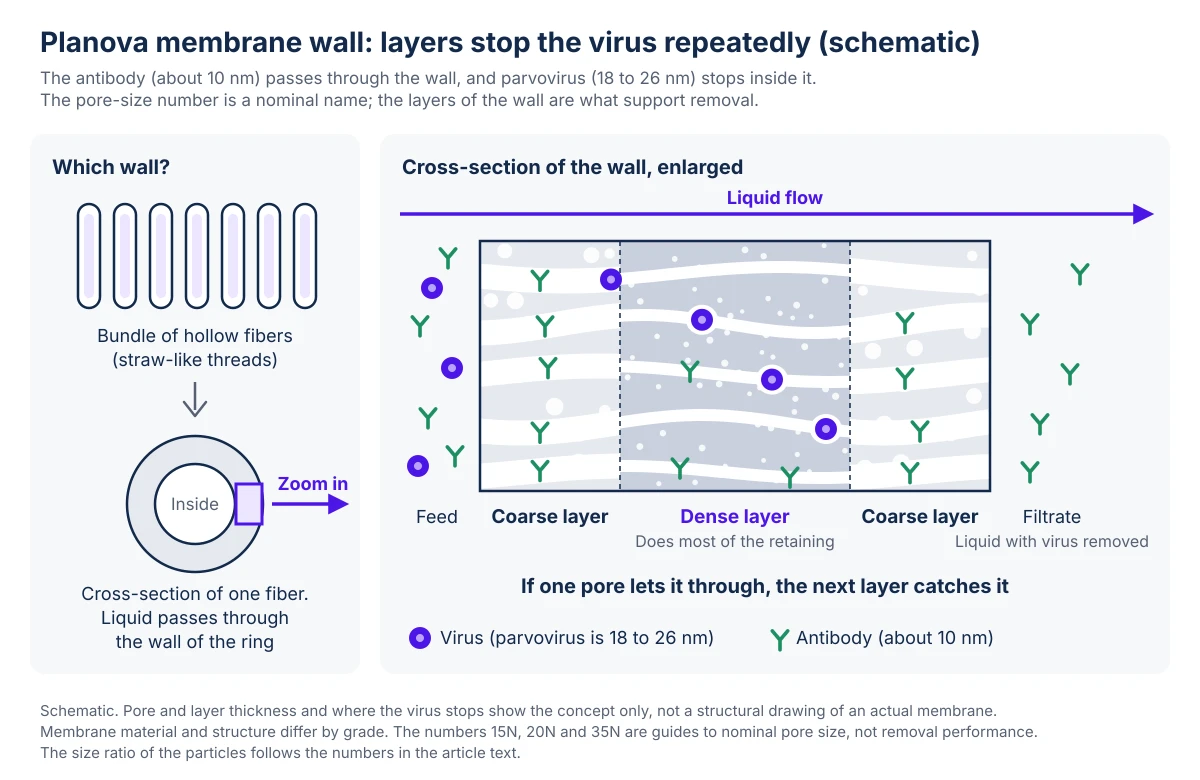
Choose the grade by the size of the target virus, then choose the material within it by the balance of throughput and how well the filter tolerates changes in operation.
Pressure and interruptions are where removal is lost
Choosing the membrane does not settle removal performance on its own. There are places in the run where it can be lost.
A review of the public data (Gröner, 2024) discusses how operating pressure and other conditions can influence retention. What draws particular attention is an interruption: a large change in pressure partway through filtration, or a pump stop that breaks the flow.
Membranes differ here as well. A research team at Penn State used particles the same size as a virus and watched them inside the membrane under a microscope. With BioEX, varying the pressure over about 0.7 to 3 bar (10 to 45 psi) did not change how the particles were captured. With 20N, capture changed at low pressure, and after a process interruption the particles that had been captured moved.
Asahi Kasei says that with the new FG1 the clearance is maintained after a process interruption. That is the supplier's statement, so it is something to confirm with your own feed and your own operation.
Fix the pressure range and the procedure for an interruption in the operating instructions. The basis for performance is operating inside the range that validation confirmed, and having data that show virus removal under conditions that include an interruption.
Write the validated pressure range and the interruption procedure into the operating instructions, and keep the data that back them.
Prefilters and throughput: clogging sets the run time
When the feed carries many aggregates or fine particles, the membrane of a virus filter clogs and the flow drops. A lower flow lengthens the filtration time, and the lot may not get filtered through in full.
So a prefilter goes upstream to take out the cause of clogging first. Where you put it also matters. A clear liquid, after chromatography has reduced the impurities, suits the filter, and the filter is generally placed late in purification, after polishing (in Japanese).
Throughput has to be read together with LRV. A study using a Planova validation model reported that changing the quality and concentration of the virus spike made no difference to removal performance. An LRV can't be compared unless you know how many liters per square meter of membrane had been passed when it was measured. Even a grade sold on high throughput will not show its full permeability if the feed properties are poor. Preparing the feed, in terms of concentration, pH and tendency to aggregate, ends up deciding throughput.
Read throughput and LRV together, and ask at what load in liters per square meter each LRV was measured.
A supplier's validation package is not your process validation
Virus removal capacity is shown by a study that spikes virus into a scale-down model, not into the full-scale unit. The design has to show that this scale-down model represents the full-scale unit, and you build that along the lines of downstream scale-down (in Japanese). The results are documented within the framework of process validation (in Japanese).
A post-use integrity test, which confirms the membrane has no defects, is also essential. The method differs by grade. Some use gold particles, and others measure air or water leakage. Check the method and the acceptance criteria for your grade in the supplier's documents.
The fact that a supplier publishes validation documents is not the same as your own process being validated.
Treat the supplier's validation package as an input to your validation, not as a substitute for it.
Five ways a Planova selection goes wrong
The first is choosing on pore size and LRV alone. Even at the same 20 nm or so, the material and structure change how well a filter tolerates interruptions and pressure changes.
The second is not turning pressure swings and interruptions into a procedure. At a plant, flow is often broken by pump stops, pump changeovers and sampling.
The third is testing without matching the prefilter. A scale-down test has to use the same configuration as the commercial one.
The fourth is not noticing that the small device used in development and the large commercial filter have different membranes. If the membrane type changes, the range of tests you have to repeat grows.
The fifth is thinking that virus filtration alone secures safety. Removal by size is not good at separating substances of similar size or dissolved impurities. Combine it with steps based on a different principle, such as low-pH inactivation, and build in a margin in total (Can you add up LRV across steps? (in Japanese)).
Fix pressure, interruption handling, prefilter configuration and membrane identity in writing, because a pore size and an LRV cover none of them.
Steps to check before you commit to a grade
These items can be used as they are when choosing a grade or checking a contractor's documents. Work through them in order.
- Decide whether the virus you need to stop is small or large, and whether the grade you chose matches that size.
- For each LRV, find out which virus was used and up to how many liters per square meter of membrane had been passed when it was measured.
- Confirm that the pressure range and the procedure for an interruption are fixed in the operating instructions.
- Look for data showing virus removal under conditions that include interruptions and pressure changes.
- Check that the prefilter in the scale-down test has the same configuration as the commercial one.
- Check that the small development device and the commercial filter use the same membrane.
- Decide how the post-use integrity test will be done, who will do it and against which criterion.
- Keep the supplier's validation documents and your own process validation separate.
Products can be compared in virus removal filters, the upstream prefilters and integrity test equipment. In September 2026, Asahi Kasei announced a benchtop automated device that supports the 35N grade (news). The basics of checks before and after use are in filter integrity testing and PUPSIT (in Japanese).
Sources
- Integration of Planova filters in manufacturing processes of biologicals improve the virus safety effectively: A review of publicly available data (Gröner). Biotechnology Progress (Wiley), 2024.
- Microscopic visualization of virus removal by dedicated filters used in biopharmaceutical processing: Impact of membrane structure and localization of captured virus particles. PubMed, 2019.
- New insights into the performance characteristics of the Planova-series hollow-fiber parvovirus filters using confocal and electron microscopy. Biotechnol Bioeng. 2019;116(8):2010-2017. PubMed Central, Aug 2019.
- Robust small virus removal with Planova virus removal filters: no effect from varying virus spike quality and concentration in a validation model. BioProcess International, Oct 2026.
- Integrity testing of Planova BioEX virus removal filters used in the manufacture of biological products. Pharma Focus Europe, Oct 2026.
- Viral contamination in biologic manufacture and implications for emerging therapies (Barone et al.), Nat Biotechnol. 2020;38(5):563-572. Nature Biotechnology, May 2020.
- Study analyzes contamination in drug manufacturing plants (April 27, 2020). MIT News, Apr 2020.
- Genzyme Detects Virus Contamination in Bioreactor, Halts Production. BioPharm International, 2009.
- Planova BioEX. Asahi Kasei Bioprocess, Oct 2026.
- Planova FG1. Asahi Kasei Bioprocess, Oct 2026.
- Asahi Kasei Introduces VANTIJ SU-VFC Benchtop to Improve Efficiency and Consistency in Gene Therapy Manufacturing. Asahi Kasei, Sep 2026.