Japan guide · Single-use vs stainless
Single-use vs stainless steel: how to choose for biologics
Photo: DIANA HAUAN / Unsplash
Single-use bioreactors were long said to top out at 2,000 L. Then in April 2025, AGC Biologics announced that its new site in Yokohama, Japan, would get two 5,000 L single-use bioreactors. In the same announcement it cited 2024 data from the research firm BDO bioTRAK showing that single-use already accounts for 51% of animal cell bioreactors worldwide.
Single-use (SU) or stainless steel: the dividing line is no longer vessel size. It has moved to how many products you run in the same building, how firm your demand is, and whether you can keep buying single-use parts without interruption. The choice fixes capital cost, operating cost, building design and staffing all at once, and it is not easy to reverse. It concerns equipment and technology-transfer staff, but also purchasing, which has to keep buying bags, QA, which reads the cleaning records, and sales, which proposes the equipment.
This guide goes through the shape of the cost, the work that going without cleaning pushes elsewhere, and the one part you cannot dual-source. It ends with the order in which to decide and a checklist you can use before a quotation or an internal approval.
Single-use or stainless: do you pay first or pay every batch?
The difference is who owns the parts that touch the product.
Stainless equipment uses fixed corrosion-resistant tanks and piping again and again, with clean-in-place (CIP) and steam-in-place (SIP) between uses. The equipment lasts, and consumables cost almost nothing per batch. In return you carry the utilities (purified water, water for injection (WFI) and steam) and the cleaning validation that shows the cleaning was sufficient (CIP and SIP explained (in Japanese)).
SU replaces the bags, tubing, filters and connectors that touch the product with new, gamma-irradiated ones every batch. In principle there is no cleaning and no cleaning validation. In return you buy the parts for every batch and throw them away after use.
That gives the two options different cost shapes. Stainless has a large up-front investment and a small cost per batch. SU keeps the up-front investment down but adds a consumables cost to every batch. Construction and start-up are long for stainless and its utilities are heavy, while SU builds and starts up faster. Changing from one product to another means waiting for cleaning and its verification in stainless, and swapping parts in SU. Stainless suits a single product at high volume with firm demand. SU suits the stage where demand is unclear, plants running many products, and products with heavy containment needs.
The break-even point moves with the number of batches per year and the consumables cost of one batch. With few batches, SU tends to win. If you make the same product at high frequency for many years, stainless, which has no consumables cost, pulls ahead. How this feeds into cost of goods is covered in the COGS breakdown (in Japanese).
Real plants do not choose one or the other. Media and buffer preparation and intermediate holds run light on single-use mixers and hold bags, while the main culture, which needs large volume, and large-scale buffer preparation go in stainless tanks. Placing each process in one or the other, a hybrid, draws attention as the realistic answer.
Single-use versus stainless is a choice between paying first and paying every batch, and because the best point differs by process, hybrids are the realistic answer.
Is capacity still the dividing line?
No. The old rule that single-use is for small scale and stainless for large no longer matches current products.
At the AGC Biologics Yokohama site, two 5,000 L vessels from Thermo Fisher Scientific and four 2,000 L vessels from Cytiva are going in, which adds 18,000 L of single-use capacity on its own. GMP manufacturing is scheduled to start in 2027 (see the Yokohama news item). The contract manufacturing site that Fujifilm opened in Billingham, UK, is also single-use, with four 2,000 L vessels and two 500 L vessels.
Meanwhile, the first phase of the site Fujifilm opened in 2025 at Holly Springs, North Carolina, started with eight 20,000 L bioreactors. That is four times the size of the single-use vessels at AGC Yokohama. Even as the single-use ceiling rises, the scale beyond it does not disappear.
What capacity decides is not whether single-use is enough. It decides how the whole plant is put together: how many vessels of what volume you run in parallel. Process intensification (such as N-1 perfusion (in Japanese)) can sometimes make the same quantity in smaller vessels.
You can no longer choose by the catalog's maximum volume; ask not "how many liters can it make" but "how many of that size will you run, and with which parts".
What work replaces cleaning when you go single-use?
The strength of SU is that you do not have to wash out the previous product. That work does not vanish; it moves somewhere else.
In stainless, each batch is washed by CIP and, where needed, sterilized by SIP, and you confirm that residual protein, detergent, microorganisms and endotoxin are below the criteria. That sequence sets how many days pass before the next batch can go in. With SU, you remove the used parts and fit new ones, and you can move on. SU is preferred at CDMOs that rotate several products through one facility, and for viral vectors with strict containment needs, because the product-contact surface is new every time. There is structurally no path for a previous product left on the equipment to mix into the next one (cross-contamination and changeover (in Japanese) covers how changeover is managed).
What disappears, however, is only cross-contamination on the product-contact surface. The building's air handling, the movement of people and materials, and shared instruments remain.
Three jobs increase in return. The first is incoming inspection of parts. You check the appearance and lot of each delivered bag, and you keep a record that the aseptic connections were made correctly every time. The EU GMP Annex 1 revised in 2022 added a subsection on single-use systems, and it asks more of the user in controlling the supplier. Sterility assurance is confirmed as part of supplier qualification, and at receipt you check the evidence of sterilization (supplier qualification and incoming inspection (in Japanese)).
The second is the evaluation of extractables and leachables (E&L). Plasticizers, antioxidants and degradation products can migrate from bags and tubing into the liquid, so you have to show they do not affect the product or the patient. This is not a test you can add after adopting a bag; it is an evaluation decided together with the choice of which bag to adopt (E&L explained (in Japanese), safety assessment of leachables (in Japanese)). Stainless has almost no E&L concern, but there you manage detergent residue.
The third is waste and the environment. The view that single-use is greener is also being shaken. GEN reported research by Jan Reiners and colleagues at Roche. It notes that the advantage of single-use, avoiding the energy for cleaning and sterilizing stainless, has thinned as emissions from electricity have fallen. It also notes that one run of a 2,000 L-scale single-use operation produces up to 6.5 tonnes of CO2 equivalent from plastic and packaging waste alone. It concludes that a plant combining both is the most sustainable. The estimate depends on how electricity emissions are counted, so it cannot necessarily be applied to your own plant as it stands.
Cleaning validation goes away, and in its place comes the job of assuring part quality together with the supplier.
Which single-use parts can have a second source?
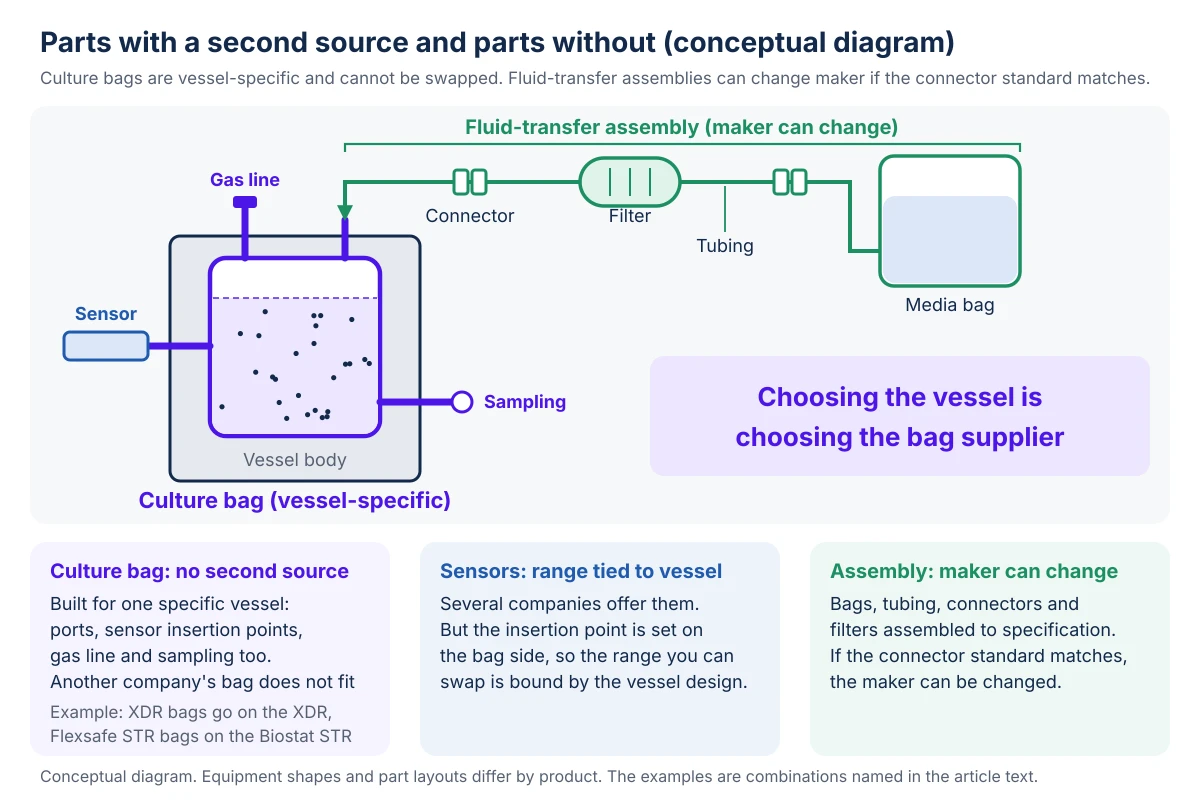
Fluid-transfer assemblies can. Culture bags cannot.
SU buys parts every batch, so a supply stoppage, a price increase or a specification change stops production directly. In 2021, with demand for Covid vaccines among other things piling up, lead times for single-use parts stretched, and an industry publication reported that some suppliers indicated waits of 10 to 12 months. The countermeasure usually raised is to qualify several suppliers, a second source. But some SU parts can have a second source and some cannot, and treating them as one group leaves the critical spot open while you think you are covered.
The part that cannot be replaced is the culture bag. The bag defines the shape inside the vessel, and each company makes it for its own vessel only. The port positions, sensor insertion points, gas line routing and sampling configuration are designed around the vessel, so another company's bag does not fit. For example, the bag for Cytiva's Xcellerex XDR fits the XDR, and the bag for Sartorius's Flexsafe STR fits the Biostat STR. Choosing the vessel is choosing the bag supplier.
The part that can be replaced is the assembly that only moves liquid: bags, tubing, connectors and filters assembled to specification. If the connector standard matches, you can change the maker (single-use assembly components (in Japanese)). pH and dissolved oxygen sensors are also offered by several companies, but the insertion point is set on the bag side, so the range in which you can swap them is bound by the vessel design.
Investment to thicken the supply does not always go to plan. ABEC's single-use container manufacturing site in North Carolina was expected to start in 2023 according to a 2022 announcement, but it opened in September 2026, about three years behind.
What to ask the manufacturer is not "how much stock do you hold". Ask instead, "when the film or component specification of this bag changes, how much documentation will you give us for the equivalence assessment?" The answer shows what you can do when supply stops.
Choosing a culture bag commits you to that vessel's maker for a long time, so work out in advance how many days production lasts if the supply of a part with no substitute stops.
What can you check tomorrow? Common mistakes and a checklist
Three mistakes are common. The first is comparing vessels on capacity alone without counting which parts cannot be substituted. The second is starting to collect E&L documentation after the bag is chosen, and then redoing the evaluation because the bag cannot be replaced. The third is expecting SU to remove the cleaning work, and then not assigning people to incoming inspection and supplier control.
The order of decision is: number of products, required scale, parts with no substitute, and E&L scope. Without the number of products, you cannot estimate the cleaning burden or the changeover days. If you decide in reverse order, you are left choosing later items while bound by earlier judgments.
Use this checklist before a specification review with a manufacturer or an internal approval.
- How many products and how many batches a year will you run? How firm is the demand?
- What scale in liters do you need? Could process intensification make the vessels smaller?
- Which parts have no substitute (the culture bag)? How many days until production stops if supply stops?
- When the film or component specification of a bag changes, will you get advance notice and equivalence documentation?
- Is the E&L documentation evaluated under conditions close to your own process?
- Do you have enough people for the checks at receipt (appearance, lot, evidence of sterilization)?
- What is the full cost, including disposal of the used parts?
- If you combine both, which processes will be single-use and which will be fixed equipment?
Candidate products can be compared on the directory pages for single-use bioreactors, single-use assemblies, single-use flow paths, transfer pumps and stainless tanks.
Related guides: how to choose the vessel itself in bioreactor selection (in Japanese), how disposable bioreactors spread in single-use bioreactors, 20 years on (in Japanese), the mixing step in choosing a single-use mixer (in Japanese), and the regulation of substances in parts in PFAS regulation and manufacturing materials (in Japanese).
Sources
- AGC Biologics Strengthens Single-Use Technology At New Yokohama, Japan Facility. AGC Biologics (via BioProcess Online), Apr 2025.
- AGC Biologics Lands Commercial Manufacturing Agreement for Yokohama Site Worth Hundreds of Millions of Dollars. AGC Biologics (via BioSpace), Jul 2026.
- Fujifilm Biotechnologies opens $3.2B cell culture manufacturing site in North Carolina. Pharma Manufacturing, 2025.
- Hybrid Single-Use and Stainless Steel Plants: The Greener Option. GEN (Genetic Engineering & Biotechnology News), Jul 2026.
- Single-use lead times up to 12 months as COVID takes its toll. BioProcess International, May 2021.
- EU GMP Annex 1: Manufacture of Sterile Medicinal Products (2022 revision). European Commission, Aug 2022.
- Annex 1 revised overview. NSF, Oct 2026.